Breast reconstruction options bring advanced care close to home
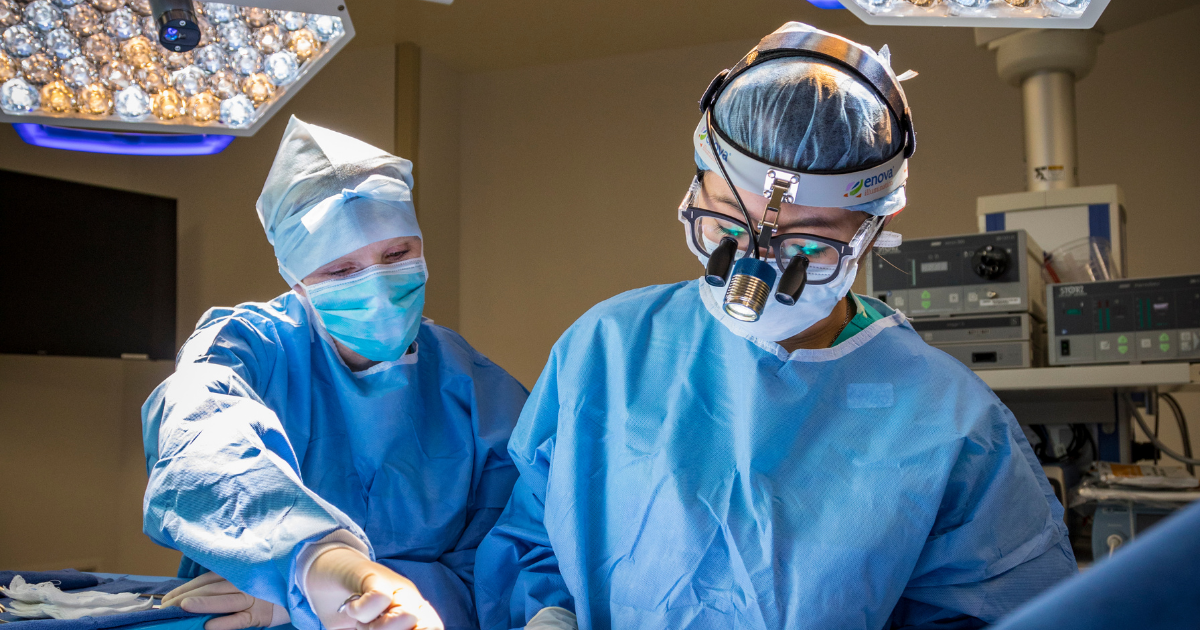
Nebraska Medicine plastic surgeons offer some of the most advanced breast reconstruction technology available, alongside care plans tailored to each patient.
Many ways to rebuild
Breast cancer patients have many choices for reconstruction, depending on what fits their body and goals. These include:
- Reconstruction using a patient’s own tissue, known as autologous reconstruction, including multiple flap-based options.
- Reconstruction with tissue expanders and implants.
Reconstruction specialists help patients understand their options and support them in the decision-making process. A key factor is the patient’s treatment plan.
“If they are going to need radiation therapy during or after reconstruction, using their own tissue is usually considered the gold standard because it holds up best to radiation,” says plastic surgeon Shannon Wong, MD.
How a patient wants to look and feel also plays an important role.
“When someone wants a more natural appearance, they may opt for autologous reconstruction,” Dr. Wong says. “It is more natural feeling, warm and will change with weight gain and loss, just like natural breasts.”
Body composition also matters. For autologous reconstruction, a patient needs enough abdominal tissue to match the size of breasts she wants.
For implant-based reconstruction, many patients start with a tissue expander, an inflatable device placed under the skin that is gradually filled over several weeks to stretch the tissue. Once the area is ready, surgeons replace the expander with a permanent implant. In some patients, going direct to implant at the time of mastectomy can also be an option.
Microsurgery expertise
Autologous reconstruction often involves flap surgery – surgeons moving a flap of tissue, along with its blood supply, from one part of the body to rebuild the breast. Some flap procedures are microsurgical, meaning surgeons detach the tissue completely and reconnect its blood vessels under a microscope.
One example is DIEP flap reconstruction, which uses skin and fat from the lower belly to rebuild the breast. Surgeons carefully remove this tissue along with its blood vessels, sparing as much abdominal muscle as possible. Then they reconnect everything to a new blood supply in the chest, working under a microscope.
Nebraska Medicine has the only plastic surgery program in the state that offers DIEP flap reconstruction.
Microsurgery makes other options possible, too. Surgeons perform lymph node bypass surgery to help prevent or treat lymphedema, a painful swelling that can happen after lymph nodes are removed.
Nebraska Medicine has one of only six programs in the country named a Comprehensive Cancer Center of Excellence by the Lymphatic Education and Research Network.
The team also uses microsurgery techniques to help restore sensation to the nipples and surrounding skin for certain patients after mastectomy.
Care close to home
Nebraska Medicine surgeons have performed a high volume of these specialized procedures, and their outcomes reflect that experience.
“We’re a pretty well-oiled machine,” Dr. Wong says of the plastic surgery and oncology teams, which often collaborate to care for breast cancer patients. “We have many experts who have done this for quite some time, and we work together in tandem.”
That expertise means patients don’t have to leave the state for advanced care or travel elsewhere for follow-up.