Family discovers crucial information through Genetic Insights Project
When Kristen Vlasak chose to participate in the Genetic Insights Project, a research study by Nebraska Medicine, she didn’t think much of it. With no family history of cancer, she had no reason to worry.
But when she received her results, everything changed.
“I tested positive for the BRCA2 gene mutation,” Vlasak says. “I was scared. I was stunned.”
BRCA2 is a gene mutation that significantly increases the risk of developing certain cancers. What Vlasak didn’t realize at the time was that her result would trigger a series of tests that uncovered vital information for her entire family.
A family’s discovery
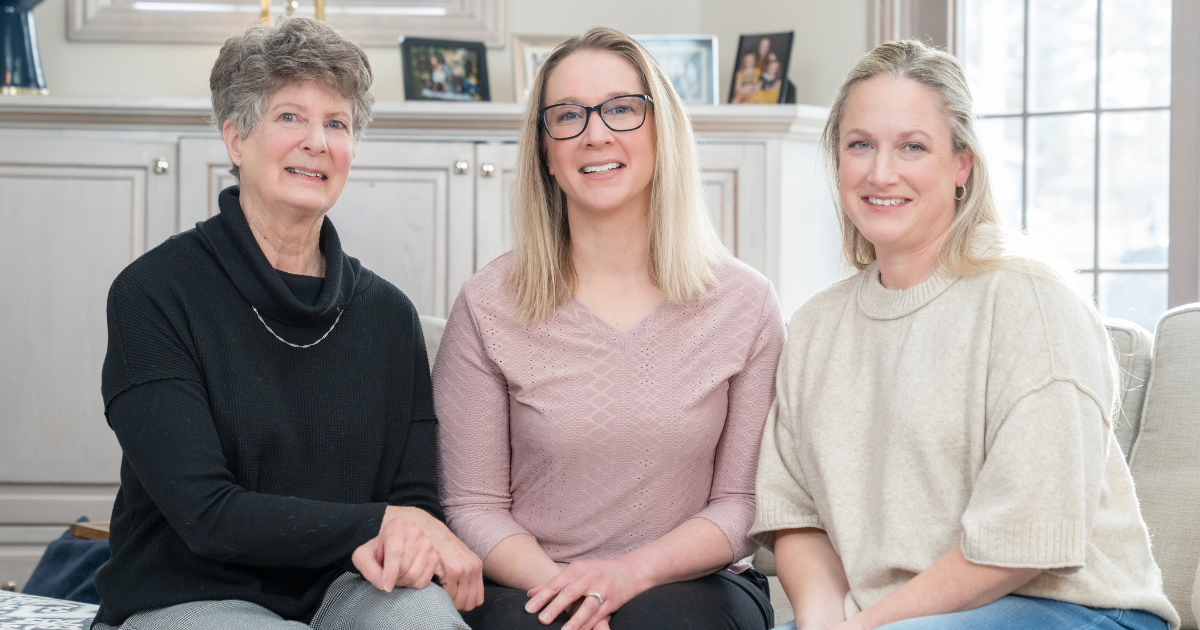
Because genetic mutations can be inherited, Vlasak immediately notified her mother, Carole Hunt, and her sister, Erin Thoman, so they could get screened as well.
“It came out of the blue,” Hunt says. “We don’t have a significant history of cancer in our family, so it never crossed my mind to even worry about it. It was shocking, and a call to action as far as, what is the next step?”
Thoman says she went into her screening assuming she probably had the mutation, too.
“There’s a 50-50 chance that I had the same gene mutation, so I’d rather think I have it and then find out I don’t, rather than thinking I probably don’t have it and find out I truly do.”
Both Hunt and Thoman tested positive for the BRCA2 mutation.
Understanding the risks
The BRCA2 gene mutation is linked to four main cancers. The two highest risks are breast cancer and prostate cancer, followed by ovarian and pancreatic cancer.
For women with the BRCA2 mutation, the risk of developing breast cancer jumps to 60% to 65%, compared with about 13% in the general population. The risk for ovarian cancer increases to 30%. For men, the risk of prostate cancer rises to 60%. Pancreatic cancer risk increases from 2% to 10%.
Taking action
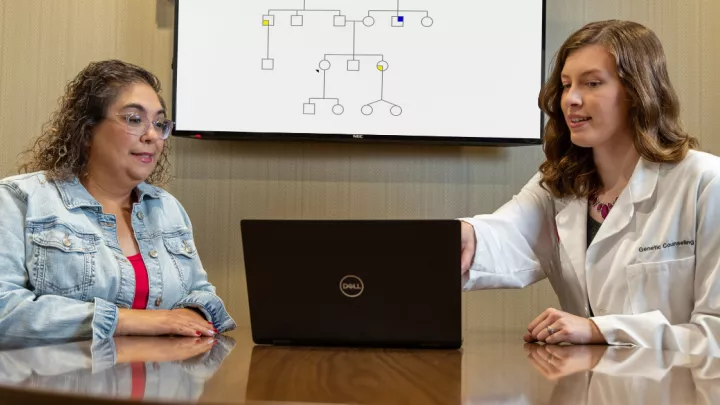
After receiving their results, all three women met with Nebraska Medicine genetic counselors through the Genetic Insights Project.
“They were fantastic,” Vlasak says. “They walked us through our results step by step, looked at our family lineage and walked us through risk factors.”
Vlasak and Thoman chose preventive double mastectomy and removal of their ovaries and fallopian tubes. After surgery, their breast cancer risk drops to less than 10%. That’s lower than the general population’s 13% risk.
Hunt chose a different path for breast cancer monitoring.
“The older you get, you can opt instead for more intense monitoring, which are yearly MRIs and mammograms,” she explains. However, she did choose to have her ovaries and fallopian tubes removed.
Why genetic testing matters
The family agrees that without the Genetic Insights Project, they would never have pursued genetic testing.
“I’m grateful for the opportunity to partake because of the results that we have,” Vlasak says. “We can take steps to hopefully prevent cancer and also have that knowledge for our kids.”
Vlasak has three daughters who will be able to get tested once they turn 19.
Thoman emphasizes another important point: “A lot of people think that it’s just for women because it’s breast cancer, but with an increased risk of pancreatic cancer and prostate cancer, it’s important for men to get tested too.”
The power of early detection
Two of the cancers linked to BRCA2, ovarian and pancreatic, can be difficult to detect in early stages. Knowledge about the gene mutation allows for increased monitoring and earlier intervention.
“So many times those cancers are found too late,” Hunt says. “Without the knowledge of the mutation and the Genetic Insights Project, I don’t think I would ever have thought twice about the risk. You don’t want to be blindsided by a cancer that could have been caught early or prevented.”
“I would much rather know that I have a high risk for developing cancer and take the steps to prevent that,” Thoman says.
An easy process
The women say Nebraska Medicine made it extremely easy to participate in the Genetic Insights Project. There is no cost to participate in the research study.
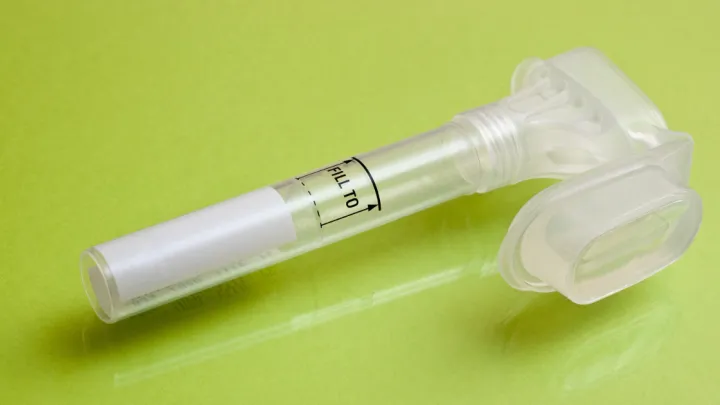
The screening process offers two options: A blood draw at a Nebraska Medicine lab location, or a convenient at-home saliva or cheek swab kit. Hunt opted for the saliva kit. “It took 15 minutes for the whole process,” she says. “It’s quick, it’s easy. You get the results in a couple of weeks.”
Moving forward together
While the journey has been emotional, the three women have found strength in facing it together. Vlasak says she went through stages of grief after her diagnosis. But having her mother and sister go through the same experience provided unexpected support.
“I think there is power in numbers,” Vlasak says. “I have them to lean on, and vice versa. We can support each other.”
The three have a group text string labeled “BRCA2.” They share updates and support each other through the process.
“It would be different if only one of us had the gene,” Hunt says. “For better or worse, it’s had its positives for our family.”
How to participate
The Genetic Insights Project is a research study by Nebraska Medicine available to anyone age 19 or older interested in learning about their genetic cancer risk. To learn more and enroll, visit NebraskaMed.com/Genetic-insights-project.
Personal risks to consider
Although the research team will take reasonable precautions to protect your privacy, there remains a risk that your information could be accessed or shared without authorization. Coded data or samples may also be re-identified. Some risks are unknown, particularly as genetic research evolves, and although unlikely, genetic information could be misused or lead to discrimination. Nebraska Medicine must have your permission to use or share health information that identifies you for this research study.
The principal investigator of this study is Douglas Stoller, MD, PhD. Genetic Insights Project, IRB #0645-23-CB. University of Nebraska Medical Center, 982265 Nebraska Medical Center, Omaha, NE 68198