Advanced treatment conquers aggressive prostate cancer
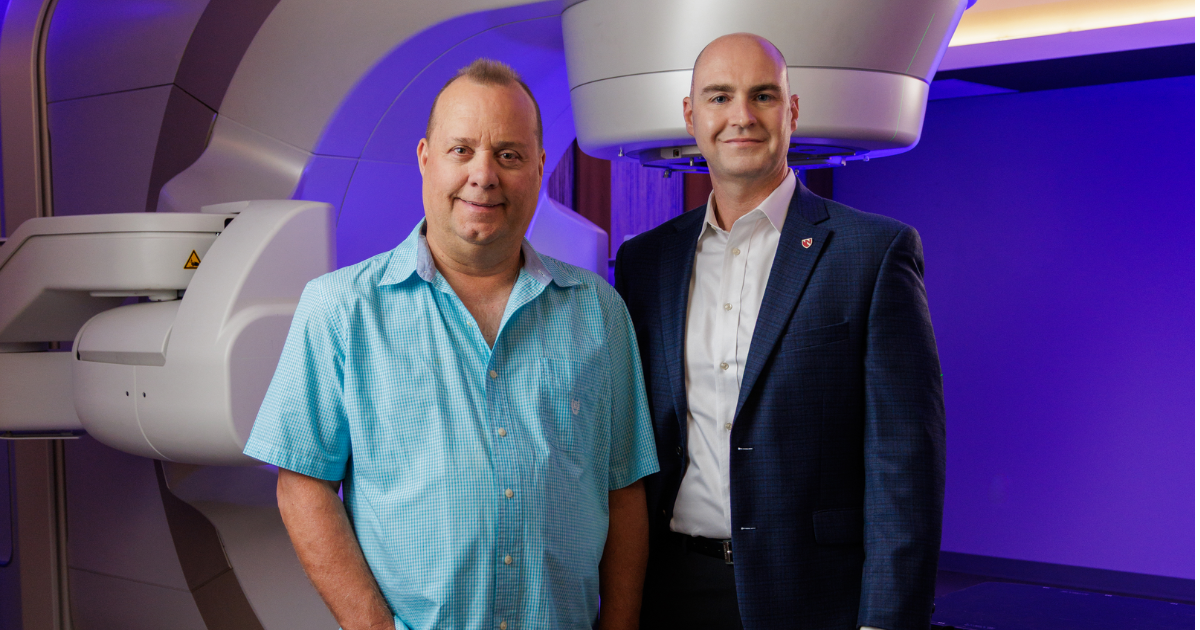
When Jeff Kramer felt a persistent backache in February 2023, he expected it to resolve on its own. The 63-year-old endured the discomfort for months before seeking care, which led to a shocking discovery: kidney cancer.
“Sure as daylight, the scan showed one of my kidneys had cancer in it,” Kramer says. “And that’s what the dull backache was from.”
During surgery at another hospital to remove his kidney, doctors found a new problem. Routine testing revealed prostate cancer. In February 2024, Kramer underwent a radical prostatectomy at the same outside institution.
“Both cancer cases were confined, so it had not spread, and I received excellent care,” Kramer says of his initial treatment.
A recurrence
Kramer’s relief was short-lived. By June 2024, just months after his prostate surgery, blood tests showed his cancer had returned. This recurrence would require specialized treatment and lead him to the Fred & Pamela Buffett Cancer Center.
The switch happened due to insurance changes, but Kramer now sees it as fortunate. A close friend battling multiple cancers offered crucial advice.
“He said, ‘Jeff, the place you want to be is Nebraska Medicine,’” Kramer says. “It feels like a godsend that that happened.”
Expert care and advanced treatment
At the Fred & Pamela Buffett Cancer Center – Nebraska Medical Center, Kramer met radiation oncologist Michael Baine, MD, PhD. Dr. Baine recommended salvage radiation therapy, a treatment used when prostate cancer returns after surgery.
“Salvage radiation therapy is generally considered standard of care and the only curative-intent treatment we have for patients who have a radical prostatectomy and then have recurrence afterwards,” Dr. Baine says.
The decision regarding Kramer’s treatment was clearcut. “He’s young, otherwise healthy, had surgery and the cancer came back despite the surgery,” Dr. Baine says. “For him, it was a bit of a no-brainer.”
Kramer’s treatment plan included 39 radiation sessions over nearly eight weeks, plus six months of hormone therapy to suppress testosterone levels. The radiation targeted the area where his prostate used to be, along with nearby lymph nodes.
Each radiation session lasted only about 15 minutes from check-in to walking out the door.
“The treatment is delivered with X-rays, so just like with a CAT scan or chest X-ray, you see nothing, feel nothing, hear nothing,” Dr. Baine says. “You just lay on a table.”
Better than expected
What surprised everyone, including Kramer’s medical team, was how well he tolerated the treatment. “I barely experienced any side effects,” Kramer says.
“My doctor was astonished, and I was too.” Dr. Baine explains that patients typically experience some fatigue and urinary changes during the final weeks of treatment. For Kramer, the hormone therapy caused only mild hot flashes. He completed his radiation course in April 2025.
Kramer’s treatment presented unique challenges due to his anatomy after prostate surgery. Small intestine loops had moved into the treatment area, requiring careful planning to avoid damaging healthy tissue while delivering effective radiation doses.
“We have an excellent team of dosimetrists here, and they were able to work their magic to deliver really good radiation for him,” Dr. Baine says. A dosimetrist works with radiation oncologists and medical physicists to ensure cancer patients get the right dose of radiation during treatment.
A bright outlook
Today, Kramer shows no evidence of cancer and has an excellent outlook. Dr. Baine believes there is “an 85% likelihood that he will be cured of this cancer after radiation.”
For others facing a similar diagnosis, Kramer offers straightforward advice:
“Go to Nebraska Medicine. And prayers. Let the people around you know what’s going on, and they’ll send prayers. You see that support coming in, and it gives you a positive attitude. You’ve got to stay positive.”
-Jeff Kramer
His experience with cancer has also shifted his perspective on health. “Don’t take health for granted," he says. "Stick to a healthy diet. Exercise. And get regular checkups, because early diagnosis is key.”
Dr. Baine notes that prostate cancer treatment is advancing rapidly. The field is seeing developments in targeted therapies, shorter treatment courses and more precise radiation delivery methods.
"We anticipate about a 40% increase in prostate cancer diagnoses in the next five years," he says. "Improved treatments will help more patients be treated in a way that doesn't fully derail their normal life."
For Kramer, the future looks bright. Nearly a month after receiving his excellent prognosis, he says simply, “I feel great.”
Don’t let fear of the unknown keep you from having a conversation with your doctor. Consider making an appointment to discuss your history, risk and which screening options are right for you. Take charge of your own health.