Doctors team up to fight extremely rare blood cancer
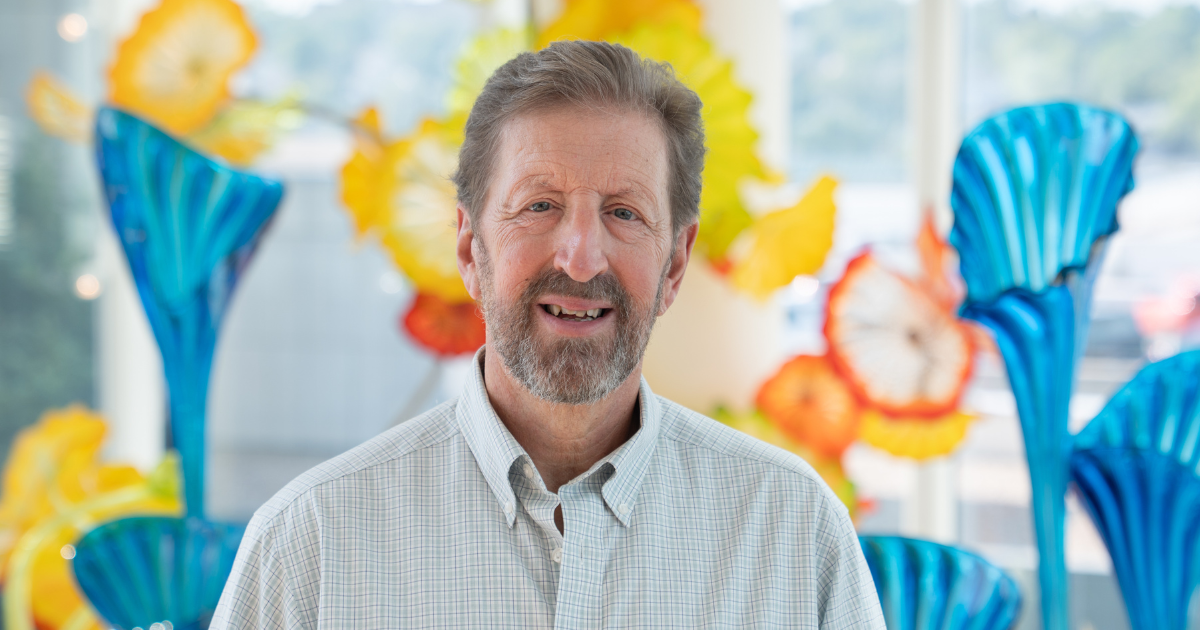
A year ago, the prognosis for Mark Moore’s blood cancer looked grim. But today, he’s hiking, traveling and sending photos to his doctors from Yosemite National Park.
His journey with Erdheim-Chester Disease – a condition so rare that as few as 20 people are diagnosed with yearly – shows what can happen when a team of specialists work together to save a life.
A mysterious diagnosis
For nearly nine months, Moore searched for answers. He knew something was wrong, but doctors couldn’t figure out what. Then he saw oculoplastic and orbital specialist, Rao Chundury, MD, MBA.
“We knew that we might encounter some diagnostic challenges with Mark’s case,” Dr. Chundury says. But the situation became urgent fast.
The night before Moore’s scheduled appointment, he went to the emergency room with sudden vision loss. Coincidentally, Mark was scheduled to see Dr. Chundury the next day.
“It was concerning because it looked like his condition was affecting his vision permanently,” Dr. Chundury says. “So, we had to do something now.”
Within an hour of his scheduled appointment, Mark was in the operating room for vision-saving surgery. Dr. Chundury performed a combination procedure with otolaryngologist and head and neck surgeon Samuel Pate, MD, taking biopsies to confirm the diagnosis and performing an orbital decompression to preserve his vision.
What normally would take weeks took pathologist Dinesh Pradhan, MD, MBBS just days, as he quickly identified the rare condition: Erdheim-Chester Disease, or ECD. The speed of that diagnosis proved critical.
A sudden turn
Moore immediately met with hematologist and oncologist, Christopher D’Angelo, MD, at the Fred & Pamela Buffett Cancer Center – Nebraska Medical Center. At first, Dr. D’Angelo thought the case would be straightforward despite being a rare condition.
“I outlined the plan and said, ‘OK, we’ll get this going in a few weeks,” Dr. D’Angelo says. “And that was the end of any kind of normalcy.”
Within 48 hours, Moore went from seemingly healthy to dangerously ill. ECD affects multiple body systems, and Moore’s body was shutting down fast.
“He got very sick. I got called about all kinds of new symptoms,” Dr. D’Angelo says. “He went from perfectly healthy to extremely sick very quickly.”
Moore spent 11 days in the hospital as doctors worked to stabilize him, as his disease impacted multiple organs. Kidney specialists evaluated him. Heart doctors treated his AFib issues. He underwent cardioversion, a heart catheterization and treatment for a gastrointestinal bleed. Oncologists performed a bone marrow biopsy.
“I was pretty scared when I saw how sick he was getting and how quickly he was getting worse,” Dr. D’Angelo says.
Finding the right treatment
Given the rarity of ECD, Dr. D’Angelo conferred with an international expert on ECD, Gaurav Goyal, MD. Dr. Goyal said there was one treatment that could save Moore’s life – a medication that attacks the specific genetic mutation driving ECD.
The disease is caused by a mutation in a gene called BRAF. The targeted drug disrupts that mutation at its source.
“We could use chemotherapy, which would be like using a cannon when really a scalpel is what’s needed,” Dr. D’Angelo explains. “By using a medicine that just targets that specific mutation, we were able to get at the root of the problem.”
Getting that medication approved and delivered to a hospital patient usually involves mountains of paperwork and red tape. But the Nebraska Medicine team understood the urgency.
“Our pharmacy team came through with the drugs later that day,” Dr. D’Angelo says. “We got that medicine for him immediately.”
Multiple specialists, one goal
Moore’s case required coordination among seven specialists – an unusual level of collaboration even in academic medicine.
Greg Bociek, MD - Medical oncology
Rao Chundury, MD - Ophthalmology
Christopher D'Angelo, MD - Hematology, medical oncology
Robert Garvin, MD - Advanced heart failure and transplant cardiology
Samuel Pate, MD - Otolaryngology, head and neck surgery
Dinesh Pradhan, MD, MBBS - Anatomic and clinical pathology
John Schleifer, MD - Clinical cardiac electrophysiology
Ken Zhen, MD - Radiation oncology
“I just don’t think there’s a lot of conditions where you see this type of coordination,” Dr. Chundury says. “Seven different providers and services for one condition can only occur at a top academic institution.”
The team included ophthalmology, ear-nose-throat surgery, pathology, oncology, cardiology, radiation oncology and hospitalist physicians. When Moore’s eyes worsened despite treatment, Dr. D’Angelo and Dr. Chundury quickly brought in radiation oncologists, who recommended a unique type of radiation that dramatically improved his vision.
“Every subspecialist he saw, I would get the note. I knew exactly what was happening at any given moment,” Dr. Chundury says. “It was just a complete, amazing coordination effort to get him the treatment that he needed.”
For Moore and his wife, Kolene, that teamwork made all the difference.
“We use this word a lot, the team aspect,” Moore says. “But that is truly what my wife and I experience coming to Nebraska Medicine – truly a team of professional health care providers.”
Climbing the mountain
As Moore recovered, Dr. D’Angelo gave him an analogy that stuck.
“Sometimes when you’re managing a hard disease like this, it’s like being at the bottom of a tall mountain,” Dr. D’Angelo told him. “Your job isn’t to climb that mountain. Your job is to put one foot in front of the other.”
Moore took that advice literally. He started increasing his daily steps, walking more, then hiking. Each week, he could see his progress on the treadmill.
“Mark really took that and ran with it,” Dr. D’Angelo says. “Every time I saw him, he got stronger and stronger and stronger.”
The doctors never made Moore feel alone in his fight. They checked on Kolene, too, understanding the emotional toll on caregivers.
“When we would show up here, we never felt like we were alone, never felt like we were isolated, never felt like we were hopeless,” Moore says. “Each of those staff, from the people at the desk to the radiology techs to the nurses, to the different services, made us feel like we belonged.”
Looking ahead
Today, Moore feels optimistic. The targeted therapy he takes as a pill allows him to travel and live his life without being tethered to a clinic. Until 2019, the prognosis for ECD patients was poor, but the approval of targeted drugs has changed the outlook.
“I feel pretty darn optimistic,” Moore says. “And because of how far we’ve come in a year’s time, I’m able to do a lot.”
Dr. D’Angelo expects Moore to continue responding well to treatment for years to come.
“Mark’s progress has been one of the most special parts of me being one of the doctors here,” he says. “Mark sent us a message from Yosemite Park in California, where he saw the sun rising over the mountains and thought that a year ago, he wasn’t so sure if he was going to be in this kind of situation. I can think of no better outcome than being able to share that moment.”
For Dr. Chundury, caring for Moore reminded him why he chose medicine.
“Every now and then, you meet a family, you meet a patient that makes you feel reinvigorated to practice medicine,” he says. “Mark and his family are like that. I’m really honored to have taken care of him, and we have become good friends.”
As Moore puts it: “It was awful, but good.”