CAR T-cell therapy and Kearney-Omaha collaboration offer cancer patient new hope
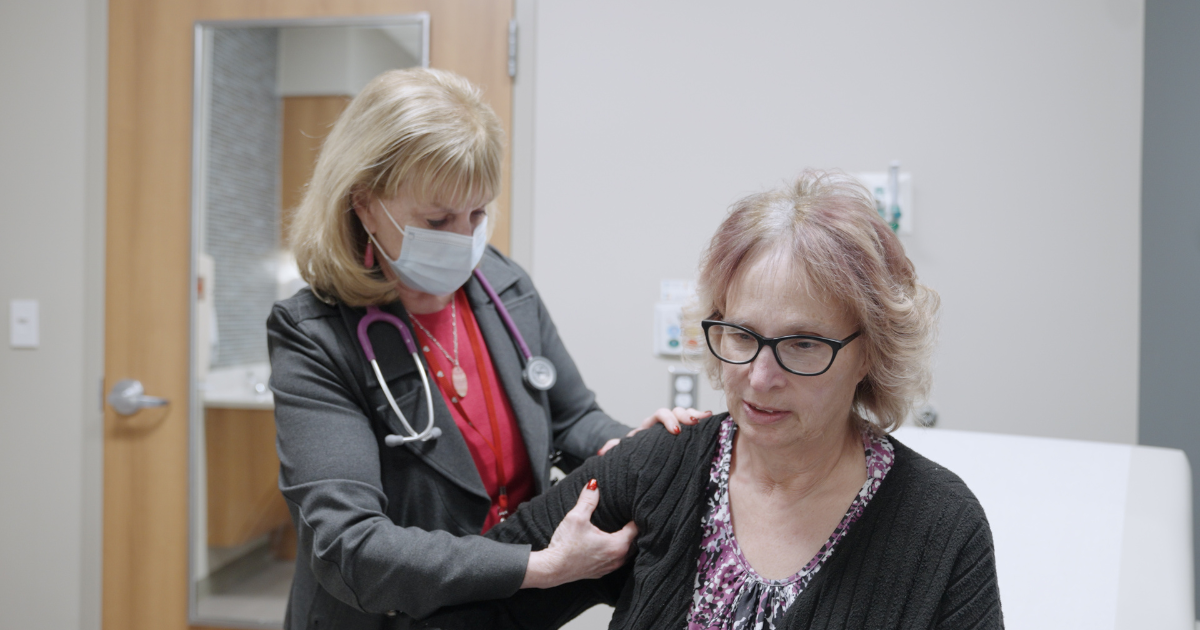
When Christine Vauthrin learned her blood cancer had stopped responding to standard treatments, she faced a grim reality. Eighty percent of her cells had cancer, and her immune system was shutting down.
That’s when her longtime oncologist in Kearney connected her with life-changing treatment through a clinical trial at Fred & Pamela Buffett Cancer Center – Nebraska Medical Center.
The Fred & Pamela Buffett Cancer Center is the only NCI-designated cancer center in the state, bringing life-changing research and treatments directly to Nebraskans facing cancer.
“This was a Hail Mary,” Vauthrin says of learning about the clinical trial. “What did I have to lose?”
Vauthrin, who lives in Kearney, received her chronic lymphocytic leukemia (CLL) diagnosis in 2011 at a Grand Island hospital.
“A physician’s assistant examined me and said, ‘I don’t know any better way to tell you this, but you have cancer,’” Vauthrin says. “I said, ‘No, I don’t.’ I was in disbelief.”
She began treatment with Nick Hartl, MD, an oncologist at Fred & Pamela Buffett Cancer Center - Kearney.
When standard treatments stop working
Over 15 years, Dr. Hartl treated Vauthrin with multiple rounds of chemotherapy and targeted therapies. Each time, the cancer returned more aggressively.
“She was running out of other treatment options, and her disease was becoming more aggressive,” Dr. Hartl says.
By late 2024, Vauthrin’s immune system had weakened to dangerous levels. She was taking three medications just to prevent infections.
That’s when Dr. Hartl reached out to Julie Vose, MD, an oncologist-hematologist at Fred & Pamela Buffett Cancer Center - Nebraska Medical Center in Omaha, about a clinical trial for CAR T-cell therapy.
“Christine was otherwise healthy and could withstand a little bit more aggressive treatment,” Dr. Vose says. “I felt that this would be an opportunity for her to hopefully be lymphoma-free for as long as possible.”
A life-changing clinical trial
CAR T-cell therapy works by removing a patient’s own immune cells, modifying them in a lab to fight cancer, then returning them to the body.
“If we used their own cells without the genetic modification, it wouldn't add that extra power to fight the cancer,” Dr. Vose explains. “So, this is an extra benefit for patients to fight their cancer in a better way, using their own cells.”
The process began in February 2025, when doctors collected blood from Vauthrin’s neck to extract white blood cells. The cells were shipped to a lab in New Jersey for modification.
A month later, Vauthrin returned to Omaha for three days of chemotherapy, followed by admission to the transplant floor. There, a medical team administered her modified cells through a port. Hours later, she developed a high fever – a known side effect. The team quickly brought it under control, and Vauthrin suddenly felt better than she had in months.
“I had this burst of energy,” Vauthrin says. “The nurses gave me a medal and a certificate for a ‘5K’ because I was walking around and around the hallways.”
She stayed in Omaha for a month for treatment and monitoring, saying the hospital staff “became my family, and I became the woman in room 82.”
Results that speak for themselves
Vauthrin returned to Kearney, where she receives monthly infusions and breathing treatments to prevent infections. Within a few months, a biopsy showed remarkable results: the cancer in Vauthrin’s cells had dropped from 80% to 10%.
“She looked so much better – she was like a new woman,” says Dr. Vose of seeing Vauthrin at her first follow-up visit in Omaha. “I think she's really thrived under this treatment.”
The partnership between the Kearney and Omaha locations is essential for patients like Vauthrin.
“Collaboration is easier because we're in the same system,” Dr. Vose says. “We use the same medical record, can see all tests that are done, treatment received and any side effects.”
This partnership allows patients to receive routine care nearby while accessing specialized treatments and clinical trials in Omaha if necessary.
“It’s important to allow the patients to get care close to home, close to family when it’s possible,” Dr. Hartl says. “And then, when needed, we’ve got close affiliation, so we can transition to get care at the university.”
Opening doors for rural patients
The Kearney location is working to offer more clinical trials locally, to start qualified patients on certain Omaha-based trials.
Every cancer treatment available today started as a clinical trial, Dr. Vose notes. These trials compare new therapies to current standards, always seeking better outcomes with fewer side effects.
“Clinical trials have always been important,” Dr. Hartl agrees. “Every treatment Christine went through had been the result of clinical trials in the past, providing steps forward in advancing health care.”
A message of hope
Today, Vauthrin describes her experience as “being reborn.” She wants other patients facing similar situations to consider clinical trials.
“What do you have to lose?” Vauthrin asks. “I had nothing to lose whatsoever by doing this. And look at me now.”
She credits not only her medical teams but also the compassionate care she received throughout her journey – from the staff who talked her through nerve-wracking procedures to other patients she met in Omaha.
“God had me in his hands, but this place is so special,” Vauthrin says. “If you come here, you’re in great hands.”
For Dr. Hartl, who has cared for Vauthrin for 15 years, cases like hers represent the best of what medicine can offer.
“We get to know our patients well during their therapy, because we see them quite often,” Dr. Hartl says. “That’s kind of a unique situation for medicine, but we enjoy getting to know our patients during their challenges.”