Millard woman becomes Nebraska's first outpatient CAR T-cell patient
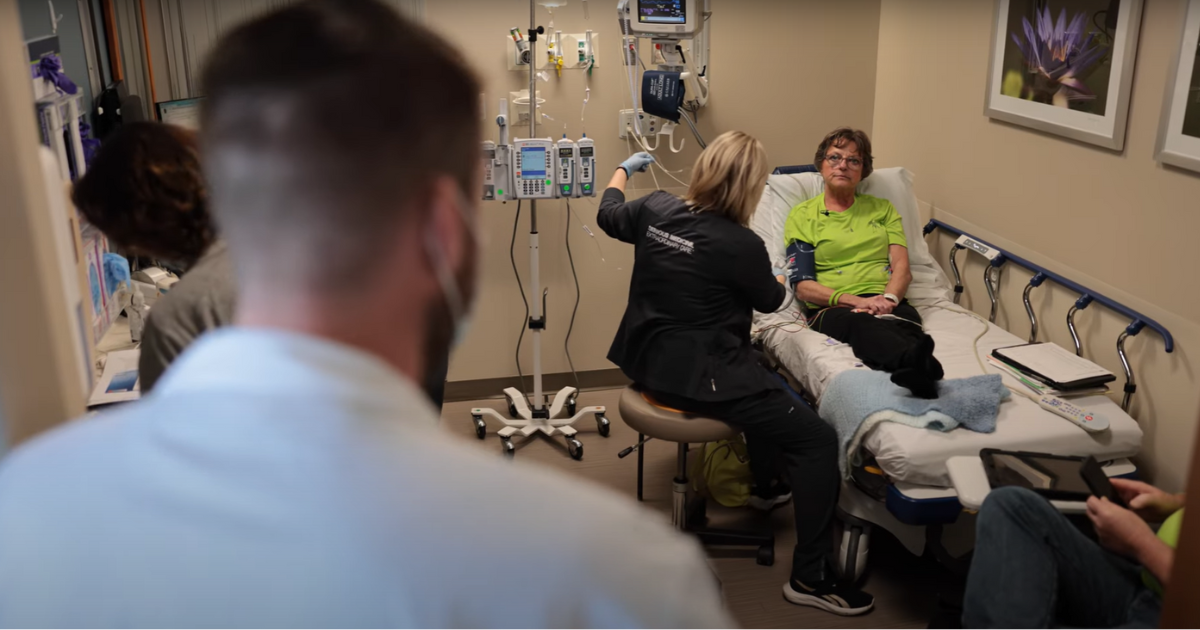
Kathy Folk never expected to become a medical pioneer. But 13 years after her cancer diagnosis, Folk made history as Nebraska’s first outpatient CAR T-cell therapy patient.
“They told me right off the bat, ‘You get to be the pioneer,’” says Folk, who was diagnosed with non-Hodgkin’s follicular lymphoma on Friday the 13th in April 2012.
The diagnosis came just months after her 50th birthday celebration. Folk had enjoyed surprise parties in June, but by Easter Sunday the following year, things changed.
“It was great turning 50 until April rolled around,” Folk says. “On Easter Sunday, I started not feeling well.”
Despite the devastating diagnosis, Folk’s primary care doctor had encouraging words.
“He said, ‘The world’s best doctor for this is right here in Omaha, and I will get you in to see him,’” Folk recalls.
That physician was hematologist and oncologist James Armitage, MD, who managed Folk's care for several years before his retirement. Nine years ago, she transitioned her treatment to hematologist Matthew Lunning, DO.
A long fight
Folk’s cancer has been stubborn. The disease has returned five times, requiring different treatments each round.
“My cancer, for some reason, likes my body and a treatment will work, I’ll be in remission, and then it finds its way back,” Folk says.
She has undergone multiple chemotherapy treatments, a stem cell transplant in 2017, and most recently, a clinical trial that worked well for about 18 months.
“In February, we came in for a six-month PET scan, and they said, ‘These aren’t the results we were looking for,’” Folk says. “I said, ‘What do you mean? You’ve got the wrong results. There’s no way.’ But it was true, and the cancer was back.”
That’s when Dr. Lunning suggested a new approach: CAR T-cell therapy, a cutting-edge treatment that uses the patient’s own immune cells to fight cancer.
Making history
What made Folk’s case special was where she would recover. Instead of staying in the hospital for the typical 10-day period after treatment, she would be in her own home.
“Dr. Lunning said, ‘If you feel you would recuperate better at home than in the hospital, you’d be the perfect patient to be our first outpatient CAR T patient,’” Folk says.
The decision wasn’t immediate. Folk discussed it with her husband Tom, whom she calls her “hero” and “rock.”
“I don’t like being a burden. I like being the giver. I do not like being the receiver of anything,” Folk says. But after talking it over, they decided to move forward.
Folk texted Dr. Lunning: “If you think that we can do this, we’re behind it 100%.”
The home advantage
As long as Folk didn’t develop a fever above 100.4 degrees lasting more than 30 minutes or showed signs of confusion, she could stay home during her recovery. She had to come in daily for blood work and check-ups with the bone marrow transplant team for 10 days, then weekly visits for several weeks.
“I got to sleep in my own bed, and I love the Fred & Pamela Buffett Cancer Center – Nebraska Medical Center, but I hate hospital beds,” Folk says with a laugh. “Do you know how hard it is to sleep in a bed that moves around?”
Being at home also meant staying close to her strong support system, which Folk calls “Team Kathy.” The network includes family, colleagues from Millard North High School and Russell Middle School, and even student athletes who wear green (her cancer’s awareness color) to support her.
“A basketball player last year wore green shoes for me. The swim team wore green swim caps for me,” Folk says. “If you’re not positive, you go down that rabbit hole, and it’s very deep – I just don’t want to be there.”
Folk’s outpatient therapy was uneventful. She was not allowed to drive for eight weeks (a protocol that has since been reduced to two weeks), but didn’t mind.
“I had chauffeurs,” she says. “I could have been upset, but I have the best support system ever.”
A ‘promise fulfilled’
Folk has been treated at Nebraska Medical Center through major changes, including the 2017 opening of the Fred & Pamela Buffett Cancer Center – Nebraska Medical Center. She praises both the facility and the people who work there.
“The Midwest is the best place you can be because people are nice. You’re a person, you’re not a number,” Folk says.
She particularly appreciates the Nebraska Medicine slogan: Serious medicine, extraordinary care.
“I’d say it’s a promise fulfilled,” Folk says. “You get extraordinary care. They do lifesaving measures every day, and everybody you meet is wonderful, kind, helpful, smart and knows what they’re doing.”
Folk travels just 20 minutes from her home for treatment at what she considers the best cancer center around.
“I don’t care what kind of cancer you have, the best place is Nebraska Medicine,” she says.
Looking forward
A recent PET scan suggested Folk is in remission, with “no new or persistent lymphoma.” If subsequent tests confirm this, her regular checkups will lessen in frequency.
Folk hopes her pioneering experience will help future patients benefit from outpatient CAR T-cell therapy.
“Being able to sleep in a nice, comfortable bed and be yourself in your own space, I think it has to help recovery,” she says.
After 13 years of fighting cancer, Folk remains optimistic.
“I’m hoping this will be the final thing that kicks this stuff out for good,” she says.
When diagnosed with cancer, you want the best treatment team behind you. Backed by the state’s only NCI-designated cancer center, patients know that by going to any of the Fred & Pamela Buffett Cancer Centers they have access to nationally recognized specialists, tailored treatment plans and clinical trials. Where you seek cancer care matters. Learn more.