TOPS procedure offers a motion-preserving alternative to spinal fusion

Spinal fusion can relieve pressure on nerves, but it also stops movement in part of the lower back. The TOPS (total posterior spine) procedure offers another option for certain patients, treating lumbar spinal stenosis while preserving movement.
Neurosurgeon Miki Katzir, MD, is the only surgeon in Nebraska who performs the TOPS procedure. He says the goal is to preserve range of motion and help eligible candidates achieve better outcomes than they might with fusion.
“There are fewer restrictions, more movement, and a quicker recovery,” Dr. Katzir says. “It’s a very unique procedure to consider if you're the right candidate.”
How does TOPS differ from spinal fusion?
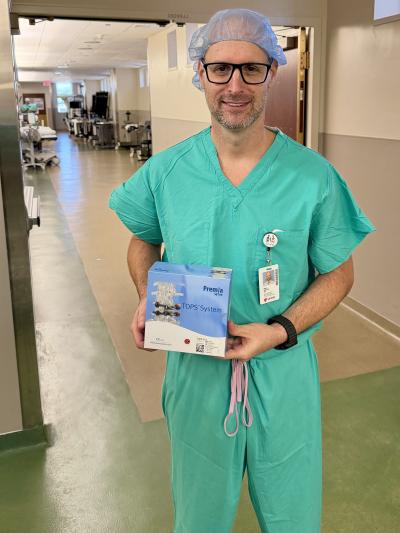
During TOPS surgery, the surgeon removes bone that is pressing on the nerves and places an artificial joint between two bones in the lower spine.
A spinal fusion holds the bones still so they can grow together. TOPS supports the spine without joining the bones, allowing that part of the lower back to keep moving.
“You’re not locking up your spine,” Dr. Katzir explains. “The artificial joint is designed to encourage movement that feels natural.”
Preserving motion with TOPS means fewer restrictions after surgery and a faster return to work and everyday activities. However, fusion may still be the safer choice when the spine is severely damaged or unstable.
Who is a candidate for TOPS surgery?
TOPS may be an option for patients with moderate-to-severe lumbar spinal stenosis or level 1 degenerative spondylolisthesis.
In general, candidates:
- Still have movement at the affected level
- Do not have severe disc damage
- Do not have major spinal instability
- Have not improved with nonsurgical treatments
A spine specialist will review your symptoms, imaging, and overall health to decide which procedure is safest for you.
What is recovery like after the TOPS procedure?
Recovery depends on the patient, but TOPS generally allows movement and physical therapy sooner than fusion. After fusion, patients usually must limit bending, lifting, and twisting while the bones heal together. That process may take several months.
Because the TOPS device is meant to move, patients do not have to wait for two bones to fuse. Dr. Katzir says physical therapy can begin earlier and recovery is usually faster.
Back surgery can be intimidating. Dr. Katzir says advances in spine surgery and recovery support can make the experience more manageable than many patients expect.
“We have physical and occupational therapy in the hospital and let you stay until you are ready to leave,” he says. “No one kicks you home the same day.”
Why isn’t TOPS more widely available?
In Nebraska, the TOPS procedure is currently offered only at Nebraska Medical Center. It is not offered as widely as spinal fusion for several reasons:
- TOPS is a newer technology that received FDA approval in 2023
- Insurance coverage varies
- Few surgeons are trained to perform TOPS, so many use traditional techniques that don’t preserve movement
“We are proud to say that surgeon education in motion preservation is our standard here,” Dr. Katzir says.
Why consider a second opinion?
A recommendation for fusion does not always mean fusion is the only possible treatment. A spine specialist who performs motion-preserving surgery can explain the options and whether TOPS fits the patient’s condition.
“Don’t get scared. Seek a second opinion,” Dr. Katzir says. “Even if you’ve been told you need fusion, we may be able to offer you this cutting-edge technology of motion preservation surgery.”
If fusion is still the safest choice, a second opinion can also help patients feel more confident about that decision.
FAQ
Is the TOPS procedure better than spinal fusion?
Neither procedure is best for everyone. TOPS can preserve movement and allow an earlier return to activity for selected patients. Fusion may be safer when the spine is severely damaged or unstable.
How long does recovery take after TOPS surgery?
Recovery time varies based on your health, symptoms, and surgical details. Because the implant is designed to move, patients can start physical therapy and daily activities sooner than after fusion.
What conditions does the TOPS procedure treat?
TOPS is used for certain cases of lumbar spinal stenosis, which narrows the space around nerves in the lower back. Candidates must also have enough remaining movement and healthy tissue at the treated level.
Does insurance cover the TOPS procedure?
Coverage varies by insurance plan and medical need. Some insurers may consider the procedure newer or require prior approval. Medicare may cover it for eligible patients.
Can the TOPS implant be revised later?
If future problems occur, the implant may be replaced or changed to a fusion. Because the screws are already in place, the surgeon may be able to remove the device and add rods if needed.
If you have been told you need lumbar spinal fusion, a second opinion may help you understand every option. Schedule a consultation at NebraskaMed.com/Spine.