Nebraska Medicine firsts: Transcatheter procedures offer solutions close to home for cardiovascular patients
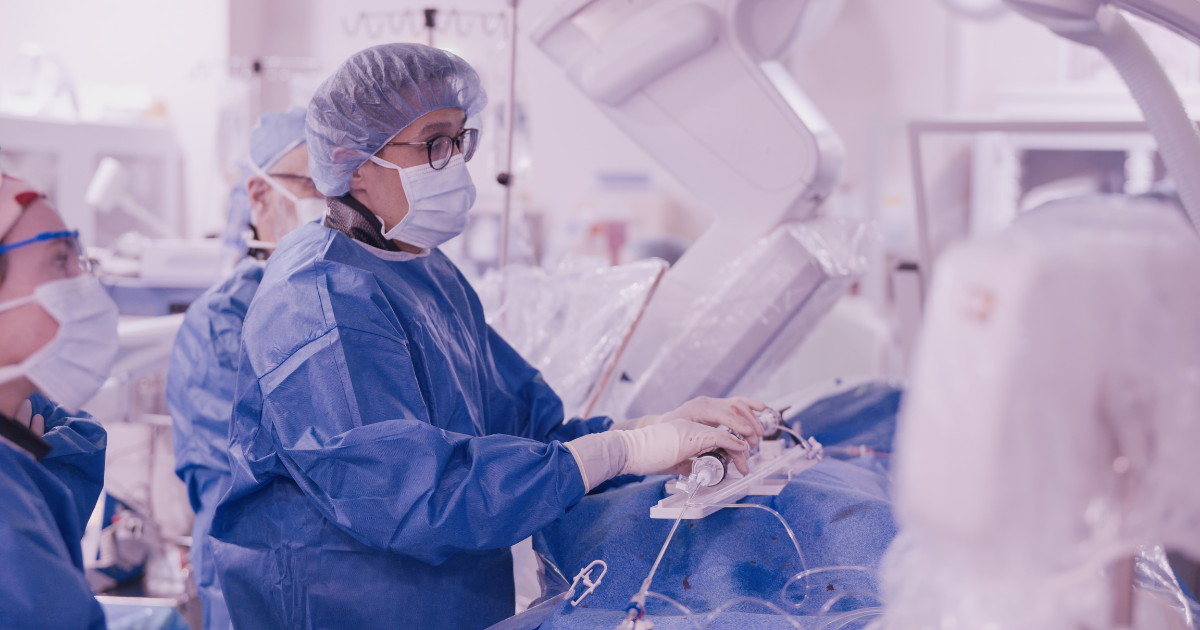
Nebraska Medicine has rapidly adopted several minimally invasive transcatheter procedures, becoming the first and only center in Nebraska to offer them.
These cardiovascular procedures offer the region more options for high-risk patients. This means that patients can access world-class care locally, avoiding unnecessary disruption, expenses and risks associated with traveling to out-of-state centers for specialized care.
Patients who are not candidates for open-heart surgery due to factors like advanced age, frailty or complex medical histories particularly benefit from these procedures. For many, they offer hope for a life-saving solution in their own backyard.
“We are excited about the new advancements that enable us to treat more complex, sicker patients right here, closer to home,” says section chief of interventional cardiology Marvin Eng, MD. “We’ve treated patients with very challenging situations and provided them with transcatheter solutions so they can get back to living.”
Recent advancements
Nebraska Medicine offers one of the region’s most robust structural heart programs, providing expertise in both repair and replacement using transcatheter approaches.
Recent firsts were led by Drs. Eng and Moulton, as well as the rest of the heart and vascular team in the past six months. Dr. Eng pioneered these types of procedures at another facility before joining Nebraska Medicine.
New transcatheter procedures include:
November 2025: Transcatheter tricuspid valve replacement.
Using the Evoque system, this valve replacement option treats severe tricuspid regurgitation. A small incision is made in the groin, followed by a catheter inserted through the femoral vein and into the heart, where the valve is placed.
December 2025: Percutaneous balloon lithotripsy for mitral stenosis (TMVL).
A stiff heart valve can lead to heart failure or stroke. This procedure improves the valve’s flexibility and reduces stiffening without damaging soft tissue. It works by inserting a small tube through a blood vessel into the heart, then using sound waves to break up calcium deposits on the rigid heart valve. A balloon is used to stretch the valve open gently.
December 2025: Undermining latrogenic coronary obstruction with radiofrequency needle (UNICORN).
This procedure modifies the aortic valve to prevent obstruction of the coronary arteries during valve-in-valve transcatheter aortic valve replacement (TAVR). It works by creating a hole in the aortic leaflet using a radiofrequency wire. A balloon is then used to enlarge the hole to enable a new valve to pass through and implant the valve inside the leaflet, thus preventing it from obstructing blood flow.
February 2026: Balloon-assisted translocation of the mitral anterior leaflet (BATMAN).
The BATMAN procedure modifies the mitral valve to prevent obstruction of the left ventricular outflow tract during transcatheter mitral valve replacement. It involves inserting a catheter through a blood vessel in the leg, guiding a balloon to the mitral valve and burning through the old leaflet already in place to insert the new valve through the hole in the leaflet. Putting the valve through the leaflet hole prevents the old leaflet from blocking blood flow to the rest of the body.
February 2026: Balloon-assisted basilica.
The Basilica was used to split part of an old heart valve to make room for a new one, replacing a failed surgical valve.
March 2026: The first transcatheter mitral valve replacement (TMVR) for native mitral valve leaking was successfully performed at the end of March.
The recently FDA-approved SAPIEN M3™system is approved for patients who are not candidates for surgery or transcatheter edge-to-edge repair (TEER). The two-step approach includes placing a docking system around the native leaflets through the femoral vein, followed by delivery of a balloon-expandable M3 valve placed into the docking system. Completely replacing the mitral valve, patients find relief from debilitating symptoms that are life-threatening.
Read how the first BATMAN heart procedure in the state gets a farmer back to work.
“We have an excellent heart and vascular team that collaborates well and has a tremendous amount of experience,” says Dr. Eng. “We’re very pleased with the outcomes of these procedures so far. I’m very proud of our team. Their skill, expertise and excellent care are what set Nebraska Medicine apart.”
Why innovative solutions like these matter
Many patients with severe valve disease are elderly or medically complex, making open-heart surgery unsafe. New transcatheter procedures offer these patients:
Reduced risk.
Avoidance of open-heart surgery.
Less pain after the procedure.
Faster recovery and shorter hospital stays.
Quality of life improvement.
The Nebraska Medicine multidisciplinary valve program brings together interventional cardiology, cardiac imaging, heart failure specialists and cardiac surgeons to evaluate patients and their individual situation. Working together to determine the best treatment path, they are dedicated to providing the highest level of cardiovascular care.