A routine mammogram, a genetic surprise and a clear-eyed choice
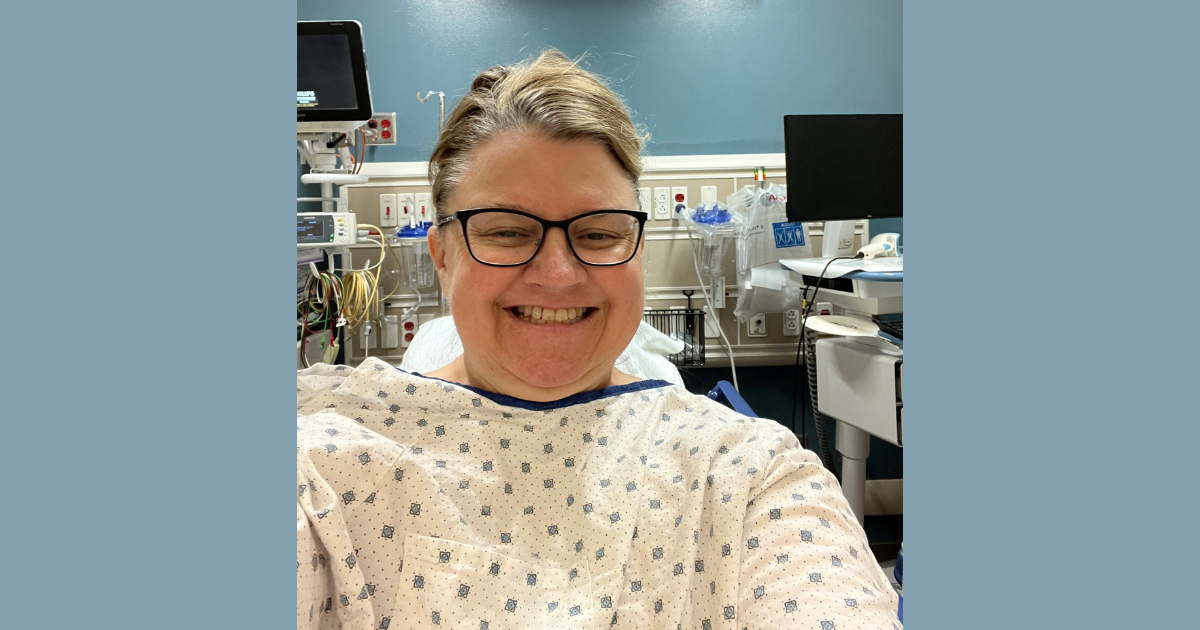
When Gretchen Oltman scheduled a mammogram in fall 2024, she wasn’t worried. She felt fine.
Oltman was just getting back on schedule after falling behind during the pandemic – inspired, she says, by hearing actress Jenna Fischer talk about her own breast cancer diagnosis on a podcast.
“I heard that and thought, I probably need to get in for a checkup,” says Oltman, an associate professor and program director at Creighton University.
That routine visit set off a chain of events that would change her life – and ultimately lead her to advocate for others facing the same uncertainty she once felt.
A small finding, a bigger picture
Oltman’s mammogram showed calcifications in her left breast. A biopsy revealed microinvasive breast cancer – a tiny focus of invasive cancer measuring less than a millimeter – surrounded by ductal carcinoma in situ, or DCIS, an early form of breast cancer confined to the milk ducts.
Because of her family history of ovarian cancer, her care team recommended genetic testing before moving forward with treatment.
The results were unexpected. Oltman tested positive for the BRCA2 gene – a mutation that significantly raises a person’s lifetime risk of breast, ovarian and pancreatic cancers, among others.
“When I got that call, it changed the entire course of events,” she says.
A team approach from day one
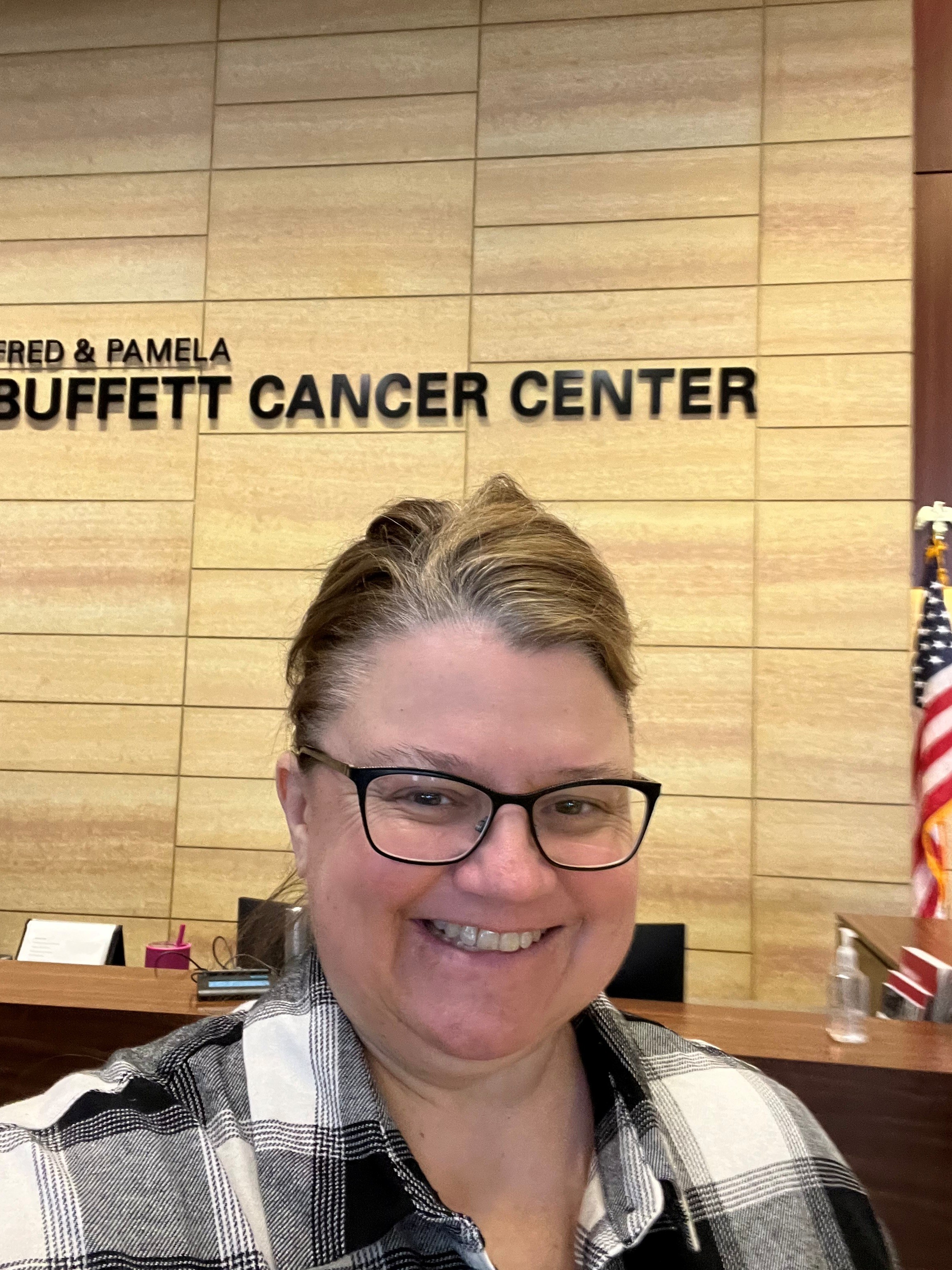
From her first appointment with the Nebraska Medicine | Fred & Pamela Buffett Cancer Center, Oltman noticed something different about her care. She met with a radiation oncologist, breast surgical oncologist, medical oncologist and genetic counselor all on the same day.
“I knew I was getting a team approach,” she says. “And I had a plan in place that day.”
Her breast surgical oncologist, Janelle-Cheri Millen, MBBS, says this kind of coordinated care matters as much behind the scenes as it does in the exam room.
“Outside of what the patients see in the appointments, as a group we meet separately and review all of their imaging and pathology results,” says Dr. Millen. “Sometimes there are nuances that are helpful for the entire group of managing providers to know at the same time.”
She adds that team-based care also spares patients from having to play messenger between providers or explain one doctor’s plan to another.
Weighing the options
With the BRCA2 result, Oltman and Dr. Millen revisited their original treatment plan.
Dr. Millen laid out three options: a lumpectomy with radiation and close surveillance; a left mastectomy to treat the cancer; or a bilateral mastectomy – removal of both breasts – to treat the cancer and reduce the risk of development of a new breast cancer in the future.
Oltman didn’t hesitate, saying she wanted to move forward with the bilateral mastectomy.
“If I had cancer, I wanted it gone,” she says. “I knew I wanted it done.”
Still, Dr. Millen encouraged her to sit with the decision for a week before committing.
“When patients have a cancer diagnosis, it certainly feels like an emergency – but objectively it isn’t,” says Dr. Millen. “The decisions that people make in terms of how they want to be treated are decisions they have to live with for a very long time. If more time is needed to consider all the options, the timeline that will change your outcomes is not one day versus two weeks.”
Oltman came back with the same answer.
Choosing aesthetic flat closure
After consulting with a plastic surgeon, Oltman chose an aesthetic flat closure – a procedure that removes all breast tissue and closes the chest smoothly, without reconstruction.
“I wanted to be done with surgery,” she says. “I wanted to be back at work. I wanted to live my life.”
Dr. Millen says there has been renewed awareness of this option in recent years, driven in part by patient communities and improved surgical techniques.
Oltman was grateful that her decision was heard and honored.
“I’ve seen cases of flat denial, where a surgeon says, ‘Of course you aren’t thinking straight – we’ll keep a little tissue for your reconstruction,’” she says. “Dr. Millen was great about saying, not just flat closure, but aesthetic flat closure. This is what we’re going to do.”
Two surgeries, one day
Because the BRCA2 mutation also raises ovarian cancer risk – a cancer that has no reliable screening test – Oltman was referred to the gynecological cancer team. She consented to the removal of both ovaries and fallopian tubes at the same time as her mastectomies.
“When I found out I had the mutation, that was the surgery I wanted done first – whether I had cancer or not,” she says.
Her care teams coordinated both procedures under a single anesthesia. Dr. Millen performed the mastectomy and aesthetic flat closure, and gynecologic oncologist Lindsey McAlarnen, MD, removed Oltman’s ovaries and fallopian tubes. Oltman went home the same day.
Pathology results were encouraging. The ovarian and fallopian tube tissue was benign. Surgeons also found a small area of DCIS in the right breast – previously undetected by both mammogram and breast MRI – confirming that the bilateral approach had been the right call.
Because of how early her cancer was caught, Oltman needed no radiation, chemotherapy or endocrine therapy.
Recovery and what comes next
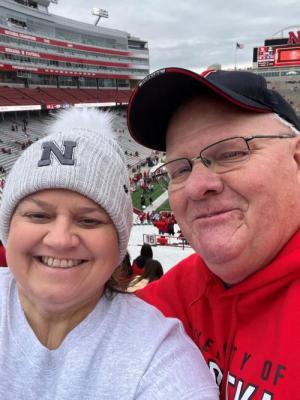
Physically, the recovery went smoothly. Emotionally, it was harder.
“It was a lot to take in at once,” Oltman says. “But I had zero complications. Every time I went in, they said, ‘You look great – this is exactly what we planned.’”
Dr. Millen says outcomes like Oltman’s reflect what early detection is supposed to achieve.
“By detecting early and treating at an earlier stage, the additional interventions people need are often less involved and less invasive,” says Dr. Millen.
For Oltman, the journey isn’t over. BRCA2 also carries an elevated risk for pancreatic cancer and melanoma. She continues annual screenings, is followed by the Cancer Risk and Prevention Clinic and is enrolled in a pancreatic cancer research study.
Turning experience into advocacy
The genetic testing process surfaced another concern that has stayed with Oltman: Learning that a positive BRCA result could affect her ability to get life, long-term care or disability insurance.
“I felt like a hostage,” she says. “Something you want to know so badly – and that you need to know for your future treatment – you’re also giving away part of the safety of your family.”
As a licensed attorney and educator, she saw the gap clearly. Health insurance is protected by federal law, she notes. Life, long-term care and disability insurance are not.
Oltman joined Facing Our Risk of Cancer Empowered (FORCE), a national nonprofit focused on hereditary cancer, and now volunteers as a policy advocate and patient community leader. She facilitates monthly online support meetings for people with BRCA mutations – and has seen the loneliness that diagnosis can bring.
“If you have a mutation, it can be really isolating,” she says. “There aren’t a lot of people around you facing the same issues.”
She has also been active in Nebraska, where legislation prohibiting insurers from using genetic testing results in coverage decisions has been introduced.
What she wants others to know
For anyone facing a similar diagnosis, Oltman’s message is direct: Get screened, trust the science and find your people.
“The science is amazing,” she says. “With science moving the way it is, there’s a ton of hope.”
She also points to her experience with Nebraska Medicine as a reason to seek out expert, academic care.
“You’re going to be with top researchers who know how to integrate that into practice – but they’re also excellent practitioners and caregivers,” she says. “I have never once met with a Nebraska Medicine caregiver who had a timetable. I’ve always gotten every question answered, and I’ve never had to rush the process.”
Screening, she says, is what made everything else possible.
“If you don’t do it, you don’t know,” Oltman says. “And you’re not hiding anything by not doing it. Screening saves lives. It saved mine.”
The best choice for cancer care
The Fred & Pamela Buffett Cancer Center is the only NCI-designated cancer center in Nebraska. Its breast cancer program includes four breast surgical oncologists, all of whom are fellowship trained. This means they all received specialized education in breast cancer after their general surgery training.
The program also includes plastic surgeons who specialize in the full range of breast reconstruction, including tissue flaps and nipple nerve reinnervation techniques, as well as strategies to reduce the risk of lymphedema.
Call 402.559.5600 to make an appointment with one of our cancer specialists.