What is MEG brain mapping for epilepsy?
If you or your child has epilepsy, you may have heard about MEG testing. But what exactly is MEG, and how can it help? This guide explains everything you need to know about magnetoencephalography (MEG) and how it’s used to noninvasively evaluate patients for epilepsy surgery.
What is MEG?
MEG stands for magnetoencephalography. It’s a brain imaging test that measures the magnetic fields produced by your brain’s electrical activity. Think of it like taking a real-time “movie” of your brain.
MEG is used to help doctors answer important questions before epilepsy surgery:
- Where are the seizures starting? MEG can pinpoint the exact area in the brain where seizures begin with incredible precision, down to the millimeter.
- Is surgery even possible? Sometimes MEG shows that seizures come from multiple areas of the brain, which means surgery wouldn’t be effective.
- What brain areas need to be protected? MEG maps important brain regions that control movement, speech, hearing and vision so surgeons know which areas to avoid.
Why is MEG important for epilepsy surgery?
When seizure medications don’t work, surgery may be an option. But before any surgery happens, doctors need detailed information about your brain. MEG provides answers that other tests can’t give as clearly.
“MEG could be a game changer,” explains Valentina Gumenyuk, PhD, core director of the MEG Center at Nebraska Medical Center. Sometimes MEG confirms that surgery is safe to move forward. Other times, it shows that surgery isn’t the right option.
Either way, MEG gives you and your doctor critical information to make the best decision.
How is MEG different from EEG?
You might already be familiar with EEG (electroencephalography), which uses electrodes placed on the scalp to measure brain activity. MEG is different and offers some important advantages:
MEG measures magnetic fields, not electrical signals. This matters because magnetic fields pass easily through your skull, skin and other tissues. Electrical signals from EEG have to travel through these layers, which can make the information less clear.
MEG Center medical director Hesham Ghonim, MBChB, compares EEG to “trying to hear a conversation behind a thick wall where you could have a vague idea of where people are standing, but the conversation is muffled and unclear.” MEG, on the other hand, picks up signals clearly because magnetic fields pass through those barriers without distortion.
MEG is especially accurate for children. Because children’s skulls are still developing, MEG often provides clearer results than EEG. MEG is also more accurate for patients who have already had brain surgery or have skull abnormalities.
What happens during a MEG test?
Before the test
The MEG team will talk with you about preparation. This might include:
- Adjusting sleep schedules (since the test is done while you’re sleeping).
- Taking a mild, short-acting sleep medication if needed.
- Discussing any concerns about the test, especially for children who may be nervous or have sensory issues.
During the test
The MEG test is comfortable and quiet. Here’s what to expect:
- The MEG helmet: You’ll lie down and place your head inside a helmet that looks like a motorcycle helmet. Unlike an MRI machine, your face stays open, and you’re not enclosed in a tunnel.
- Comfortable environment: The room is quiet with dimmed lights. You’ll lie on a bed with a pillow in a comfortable position.
- Parents can stay: For children, parents are welcome to stay in the room during the entire test. This helps kids feel more comfortable and allows parents to give feedback if their child has a seizure during recording.
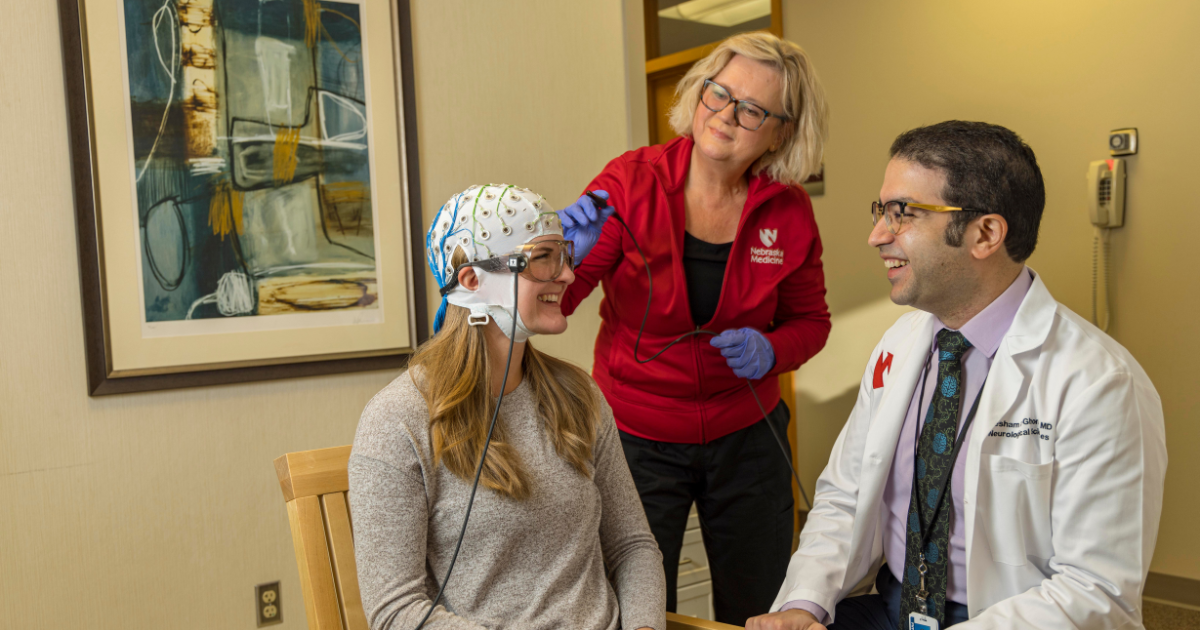
- Electrodes (usually): Most patients wear electrodes on their head along with the MEG helmet. However, for children with sensory issues, the test can be done with MEG alone, with no electrodes required.
The entire test typically takes several hours, and you will sleep most of the time.
What makes MEG testing at Nebraska Medical Center special
Fast results when you need them
Time matters when you’re dealing with frequent seizures. The MEG Center at Nebraska Medical Center provides results within just a few days.
Urgent scheduling available
If your doctor marks your referral as “urgent,” the MEG Center will fit you in. “We will find the time to schedule this patient in an urgent manner,” Dr. Gumenyuk says.
Every patient gets results
Some MEG centers report “no results” when patients can’t fall asleep or don’t cooperate with the test. The Nebraska Medicine team works differently.
“We try to minimize negative results as much as possible, and in fact, we are the champions of this,” Dr. Gumenyuk says. “Every patient has a result from our study.”
How do they do this? The team spends time before your appointment understanding your individual needs. They work with you on sleep strategies, help children feel comfortable with the equipment and adjust their approach for patients with special needs like autism.
Experience with all ages
The MEG Center treats patients of all ages, from newborns to adults in their 80s. About 40% of patients are children and 60% are adults. The team has specialized training in working with pediatric patients, including those with autism spectrum disorder who may need extra support.
Is MEG right for you or your child?
MEG testing may be helpful if:
- Seizure medication isn’t controlling your epilepsy.
- Your doctor is considering epilepsy surgery.
- You need to know exactly where seizures are starting.
- Seizures are near important brain areas that control movement, speech or other critical functions.
- You need urgent evaluation because of frequent seizures.
The bottom line
MEG testing is a powerful tool that can guide treatment decisions for people with drug-resistant epilepsy. It provides precise information about where seizures start and where critical brain functions are located. This can make the difference between a successful surgery and one that causes problems.