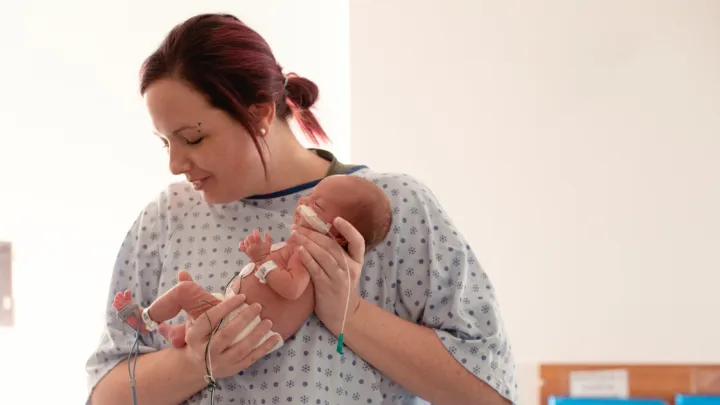
What do speech therapists do in the NICU?
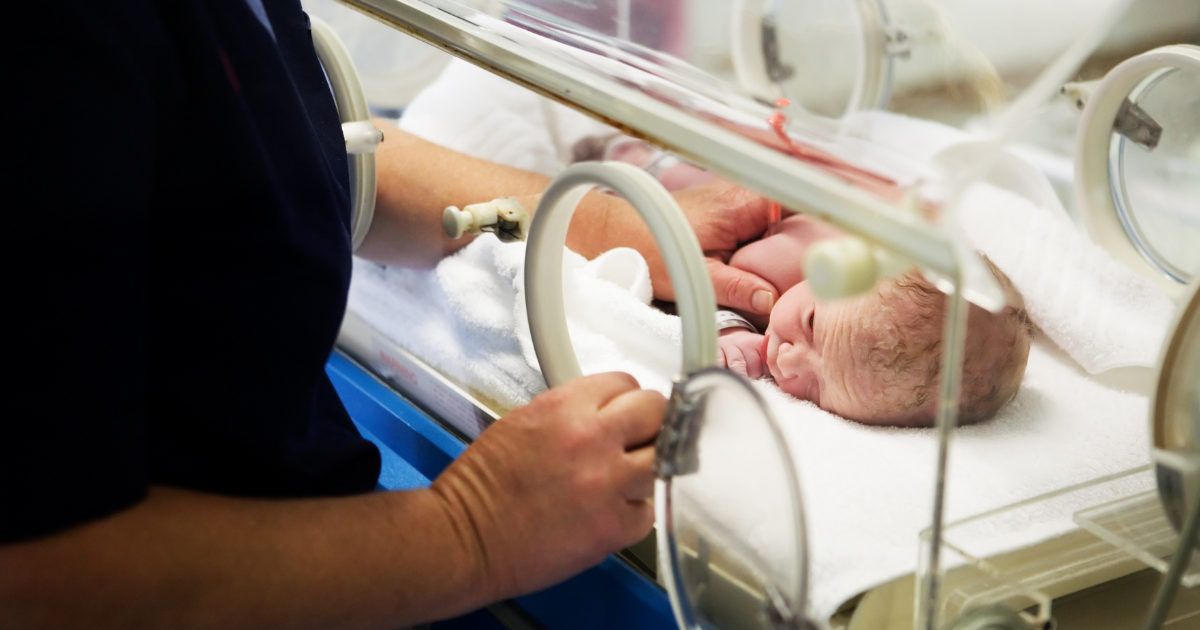
When parents hear that their newborn needs to work with a NICU speech therapist, some are confused. After all, babies can’t talk – so what could a speech therapist possibly do?
Speech language pathologist Hanna Mueller, MA, CCC-SLP, who works in the Nebraska Medical Center NICU, explains that her role goes beyond helping children learn to speak.
“Despite the more casual title of ‘speech therapy,’ our education and specialized training allow us to offer a breadth of knowledge, not only about early communication, but also about feeding and swallowing,” she says.
Why NICU babies need feeding support
In the NICU, speech therapists focus primarily on helping babies learn one of life’s most basic skills: eating safely.
“We work with infants, families and the rest of the care team to develop and implement individualized feeding plans and pre-feeding plans to address feeding and swallowing needs as they’re growing, and help them transition from hospital to home,” Mueller says.
Many NICU babies face feeding challenges because they were born early.
"Their feeding skill development progresses differently outside the womb due to the additional demands placed on the infant’s system that were not required in utero," Mueller says. “This includes the need to breathe, which often requires oxygen support, and an immature GI system.”
Certain medical conditions also increase the likelihood that a baby will need support, including genetic disorders, cleft lip or palate, neurological disorders and severe prematurity.
The challenge of coordination
The biggest hurdle for many NICU babies is learning to coordinate three essential actions: sucking, swallowing and breathing.
Here’s how this skill typically develops:
- 12 weeks in utero: Swallowing begins.
- 32 weeks: The sucking, swallowing and breathing sequence emerges, but is poorly coordinated.
- 32 to 34 weeks: Nutritive sucking develops but remains immature until term.
- 36-40 weeks: Emergence of a coordinated suck-swallow-breathe pattern.
When babies can’t coordinate these actions properly, liquid can enter their lungs instead of their stomach. This is called aspiration, and it can be dangerous.
“It can lead to lung infections – they get sick and then they stay in the NICU longer,” Mueller says. “They may develop aspiration pneumonia, which requires more respiratory support and takes time to recover from.”
Oral feeding is halted or limited until the cause of aspiration is identified and the feeding plan is updated accordingly. After recovering, the baby is able to continue working toward full oral feedings and discharge from the NICU.
Building positive feeding experiences
Beyond safety, speech therapists work to make sure babies have positive early feeding experiences. Mueller compares it to teaching a child to ride a bike.
“If they get on that bike and don’t have a good experience, they’re going to be very hesitant to do it again,” she says. “But if they have a great time and feel safe and supported, they’re going to be excited to do it again. It’s the same thing with feeding.”
This approach helps prevent oral aversion – when babies become resistant to eating because of negative experiences.
How speech therapists help
Speech therapists in the NICU provide several types of support:
- Assessment and evaluation: Speech therapists carefully evaluate each baby’s feeding abilities by:
- Examining facial and mouth structures.
- Testing how well babies use a pacifier.
- Watching babies during feeding sessions.
- Collaborating with lactation consultants to help with breastfeeding goals.
- Trying different bottles and nipple types.
- Looking for signs of swallowing problems.
- Individualized care plans: Each baby gets a customized plan that may include:
- Oral motor sensory input practice with a pacifier dipped in formula or breastmilk.
- Specific feeding strategies.
- Modified barium swallow studies (when needed).
- Collaboration with nurses and families.
- Family education: Families play a key role in helping their babies learn to feed safely.
“We try to include caregivers as much as possible since they’re going to be the primary feeders after discharge,” Mueller says. “We do this by having them feed, teaching infant cues and offering suggestions for strategy implementation.”
Warning signs to watch for
Speech therapists look for several signs that a baby might need feeding support, including:
Behavioral signs:
- Eyelid flickering.
- Worried facial expressions.
- Refusing to eat.
Swallowing signs:
- Audible swallows.
- Coughing or choking.
- Changes in heart rate or oxygen levels.
Breathing signs:
- Urgent or squeaky breathing.
- Holding their breath.
When therapy begins
“Therapy can begin as early as 32 weeks, depending on medical stability,” Mueller says. At this early stage, therapists focus on non-nutritive sucking with a pacifier. Actual feeding attempts typically begin around 34 to 36 weeks.
Some babies continue to need support after leaving the NICU. “Therapy can be beneficial past discharge for infants who continue to face feeding challenges,” Mueller says. “The duration of therapy will depend on the complexity of their feeding challenges.”
A team effort
Speech therapists work closely with the entire NICU team, including nurses, doctors, lactation consultants and other therapists. They attend rounds and check in regularly with nurses who spend 24/7 with the babies.
“We rely on our nursing colleagues to help us identify what strategies are working or not working when we are not present,” Mueller says. “They know their babies so well.”
Working with these tiny patients isn’t just about developing feeding skills – it’s about helping NICU families succeed.
“Our greatest joy is supporting parents as they achieve their feeding goals with their infant,” Mueller says. “It’s one of the first things that parents are teaching their kids among many great things they’re going to teach in the years to come.”
If your baby needs specialized care after delivery, Nebraska Medicine is here to guide and support your family every step of the way. Learn more about the Nebraska Medicine’s Newborn Intensive Care Unit.