Employee cancer survivor wants to be a beacon of light for other patients
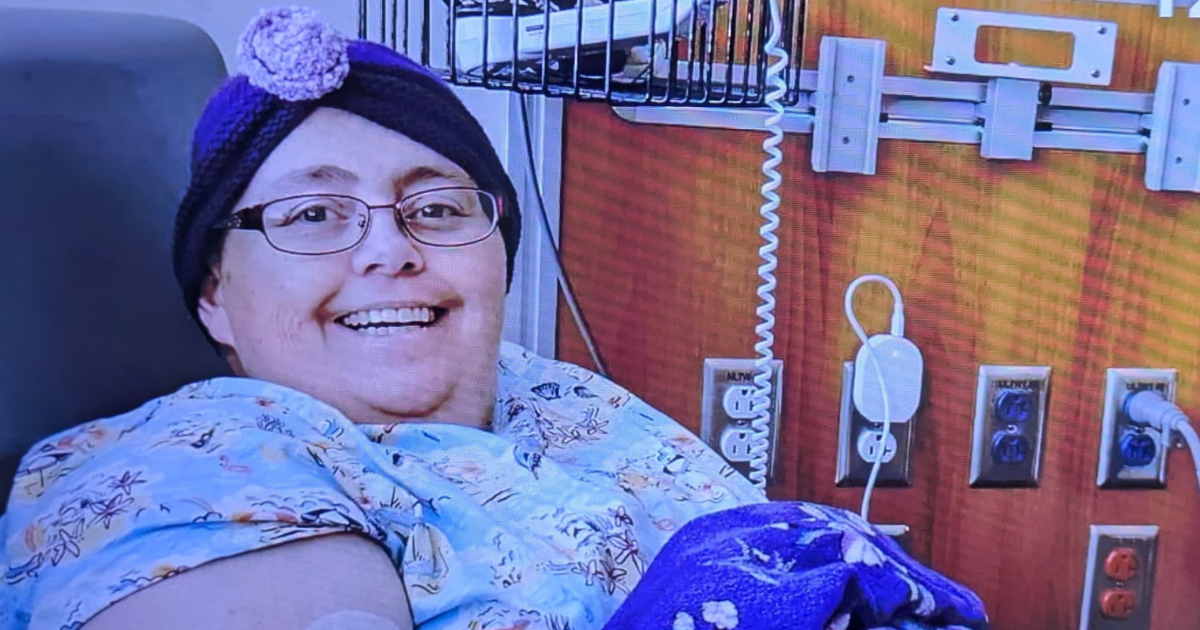
Lisa Fennell likes to say she has two families – her family at home and her Nebraska Medicine family.
A food services employee at Nebraska Medicine for more than five years, Fennell, 46, took a leave of absence in May 2024 after being diagnosed with a type of blood cancer called myelodysplastic neoplasm. She’s expected to complete treatment with a clean bill of health in July and return to work.
Fennell says she can’t wait.
Part of the family
The support she has received from her family at home and her family at Nebraska Medicine Center has been the inspiration and motivation she needed to stay positive and keep fighting.
“Everyone here took such great care of me,” she says. “They treated me like a member of their own family.”
Fennell holds a special place in her heart for one of the housekeepers on the seventh floor of the Fred and Pamela Buffet Cancer Center. She looked forward to seeing him each day. “He was always so encouraging and motivating,” she recalls. “When I saw him, I could always count on him to brighten my day.”
Now she wants to pass that positivity forward and be a “beacon of light and positive energy for other cancer patients” when she returns to work.
“I can speak from experience now,” she says. “I want to have a positive influence on others dealing with the same thing.”
Fennell says finding a motivating factor to help her fight through treatment was critical. “For me, it was knowing I would get to return to work again when it was all over,” she says. “I love working at the Nebraska Medical Center.”
Fennell has a knack for nurturing special relationships with nearly everyone she meets. Her co-workers fondly call her “bubbles” because of her lively, positive and bubbly personality.
“I can’t wait to go back and share that positive energy with them again,” says Fennell.
What is myelodysplastic neoplasm?
Myelodysplastic neoplasm (also known as myelodysplastic syndrome) is a form of blood cancer in which the bone marrow, which is responsible for producing blood cells, produces abnormal cells instead of healthy cells. This results in a shortage of healthy red and white blood cells and platelets, which can cause anemia, increased risk of infections and bleeding problems.
Symptoms of myelodysplastic neoplasm typically include:
- Fatigue.
- Weakness.
- Shortness of breath.
- Frequent infections, easy bruising or bleeding.
Fennell remembers those symptoms well.
An unexpected journey
In January of 2024, Fennell had surgery to remove her gallbladder. She expected to start feeling better a few weeks after surgery, but symptoms of fatigue and weakness continued. A blood test showed that her white blood cell count was low, but her doctor attributed it to her body recovering from surgery.
They opted to have it rechecked again a couple of weeks later. When a second test continued to show deficient white blood cell counts, Fennell was referred to Nebraska Medicine hematologist/oncologist Vijaya Bhatt, MBBS. A subsequent bone marrow biopsy found cancer cells.
After further evaluation, Fennell was diagnosed with myelodysplastic neoplasm.
“Some cases of myelodysplastic neoplasm can be slow growing and may not require treatment for many years,” notes Dr. Bhatt, “but we found Lisa’s type to be more aggressive after blood counts continued to drop with subsequent blood tests.”
Fennell, who was just 46 years old at the time, was determined to be a good candidate for a transplant because of her young age and excellent health. Dr. Bhatt started her on a regimen of chemotherapy while the search for a blood or bone marrow transplant donor began.
Fennell was also advised to stop working to focus on treatment. “I was devastated,” says Fennell. “I just love my job and all the wonderful people I get to work with.”
Unfortunately, her brother and sister were not compatible matches, so the National Marrow Donor Program registry was contacted to find a compatible donor. A match was found a few months later. In September of 2024, Fennell began the treatment process for a transplant.
“I have called this journey my climb up Mount Everest,” says Fennell. Since completing the transplant and fighting through a couple of bouts of graft versus host disease, Fennell is on her climb down. “Sometimes I just want to drop my bags and start running, but I know it’s a process and I’m almost to the end when I can happily say that I’m in survivorship mode,” Fennell says.
The road to recovery
Dr. Bhatt says Fennell has been an excellent patient and expects her to do well going forward.
“Her bone marrow shows no signs of cancer,” says Dr. Bhatt. “Compared to even a few years ago, we are seeing more positive outcomes with blood or bone marrow transplants due to improvements in technology and treatment drugs.”
Nebraska Medicine’s blood and bone marrow transplant program has been ranked as one of the busiest adult and pediatric stem cell transplant programs in the world. Since its inception in 1983, it has performed over 6,000 transplants.
“The program’s success comes from its vast experience and a multi-disciplinary team approach that includes collaboration with oncologists and specialists at Nebraska Medicine, as well as partners at other centers,” says Dr. Bhatt.
“It’s important for patients to be referred to our team as quickly as possible if a blood cancer is suspected so that we can evaluate the patient, determine the exact cancer diagnosis and develop the most effective plan of care,” explains Dr. Bhatt.
“Because blood cancers are not as common as most other types of cancers, it really requires specialized care from a team of specialists experienced at treating blood cancers to deliver the most effective care. Once an accurate diagnosis and treatment plan have been developed, we often work in collaboration with the patient’s hometown doctor so chemotherapy can be done at the hospital in their community when appropriate.”
The Nebraska Medicine transplant team also works closely with the National Marrow Donor Program to find suitable donor matches for patients. “This needs to be done on a timely basis as there is a window of opportunity for performing the transplant that will yield the most positive outcomes,” says Dr. Bhatt.
In addition, the team performs gene sequencing for patients with blood cancer to determine if a hereditary mutation is responsible for the cancer.
“This may affect whether we can use family members as donors and can also have an impact on what treatments we use if a genetic mutation is found,” Dr. Bhatt says. “These are things that may be overlooked if you are not experienced at treating blood cancers.”
Fennell says she wanted to share her story because of the amazing care she has received at Nebraska Medical Center. She also wants to remind others that if they’re not feeling right, to follow their instinct and keep pursuing an answer. “Don’t put it off,” she says.
Her experience has been a journey, she says, but she is nearly at the end and couldn’t be happier. “I just want to be normal, healthy and go back to work again. And my family at the Nebraska Medical Center is making that possible.”