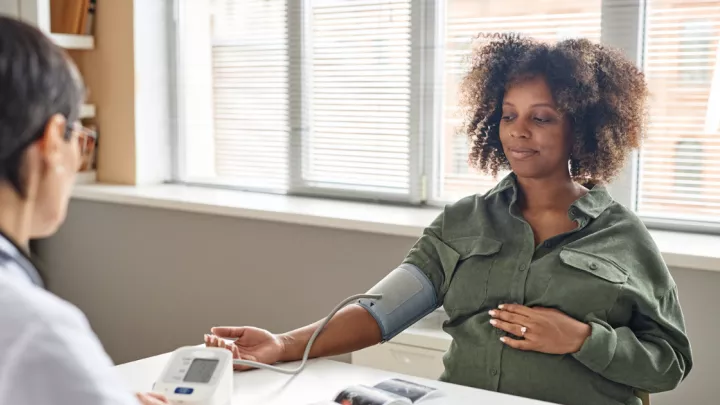
First in the state to develop strategy to test pregnant women at high risk for preeclampsia

Preeclampsia can cause serious complications—and even death—if left untreated. The condition develops during pregnancy, often causing high blood pressure and affecting organs like the kidneys and liver.
It’s especially dangerous because many women do not experience any symptoms.
We’re now the first in the state of Nebraska to implement a strategy to offer a new blood test that more accurately predicts whether a woman will develop severe preeclampsia during pregnancy.
The FDA-approved test helps our physicians, together with other health data, assign a risk level to women hospitalized with high blood pressure in pregnancy for developing severe preeclampsia within a two-week period. The test was developed thanks to the ground-breaking research of Sarosh Rana, MD, chair of the UNMC Department of Obstetrics and Gynecology.
“For years, we've watched women suffer because we couldn't tell who is truly at risk for preeclampsia,” says Dr. Rana. “Traditional tests like blood pressure and protein in urine are poor predictors of severe preeclampsia or its related complications. This leads to women being hospitalized for weeks unnecessarily, while others at real risk go home and suffer from complications.”
The test works by detecting two blood proteins (sFlt-1 and PIGF) which can predict poor outcomes from preeclampsia.
“These biomarkers can predict severe preeclampsia with up to 94% accuracy within two weeks,” says Dr. Rana. “That's a game-changer. Now, we can identify which moms need intensive monitoring and which can safely be managed expectantly and their pregnancy continued. This research represents hope for every pregnant woman and their family."
In collaboration with Maternal Fetal Medicine specialists Neil Hamill, MD, and Rebecca Rimsza, MD, Nebraska Medicine began offering these tests in late October to hospitalized patients between 23 and 35 weeks of pregnancy who displayed symptoms of preeclampsia or those at high risk.
Dr. Rana says work is underway to expand the indication of this test to be used in triage or an outpatient setting to identify high-risk patients and reduce unnecessary hospitalizations.
“Because it’s not a screening test, it should only be used when there is suspicion of preeclampsia,” adds Dr. Rana.
“This is just the beginning,” she continues. “As we gather experience with this testing, we'll work to expand access across our network and potentially to partner hospitals throughout the state. Our goal is to ensure that every Nebraska woman who needs this test can get it.”
As the new chair of UNMC Department of Obstetrics and Gynecology. Dr. Rana’s top priorities include:
- The MOTHER Nebraska Initiative—Maternal Outcomes Through Health Care Expansion in Rural Nebraska. Many Nebraska counties are maternal health deserts and lack adequate obstetric services, which means high-risk moms may not get specialized care in time.
- Implementing the STAMPP-HTN program (Systematic Treatment and Management of Postpartum Hypertension), which emphasizes blood pressure monitoring and hypertension care that improves the quality of care of postpartum mothers.
- Addressing health disparities for women who are Black, Native American and live in underserved communities. Through community partnerships, telehealth and tools like preeclampsia biomarker tests, we can provide high-quality care regardless of where a woman lives or what she looks like.
- Improving data collection. Nebraska has gaps in tracking maternal health that make it hard to measure progress. We're working to build systems that help us understand problems and implement evidence-based solutions across the state.
“Nebraska faces unique challenges,” says Dr. Rana. “Our maternal mortality rate is 25.1 per 100,000 births, and our infant mortality rate has increased 23% over the past decade. These numbers tell us we need to do better.”
The Nebraska Medicine Olson Center for Women’s Health offers comprehensive, personalized health and wellness care before, during and after pregnancy. Consider scheduling a new pregnancy appointment online or call 402.559.4500 to schedule a preconception counseling visit to assess your risk.