What is a dermatopathologist, and how are they different from a dermatologist?
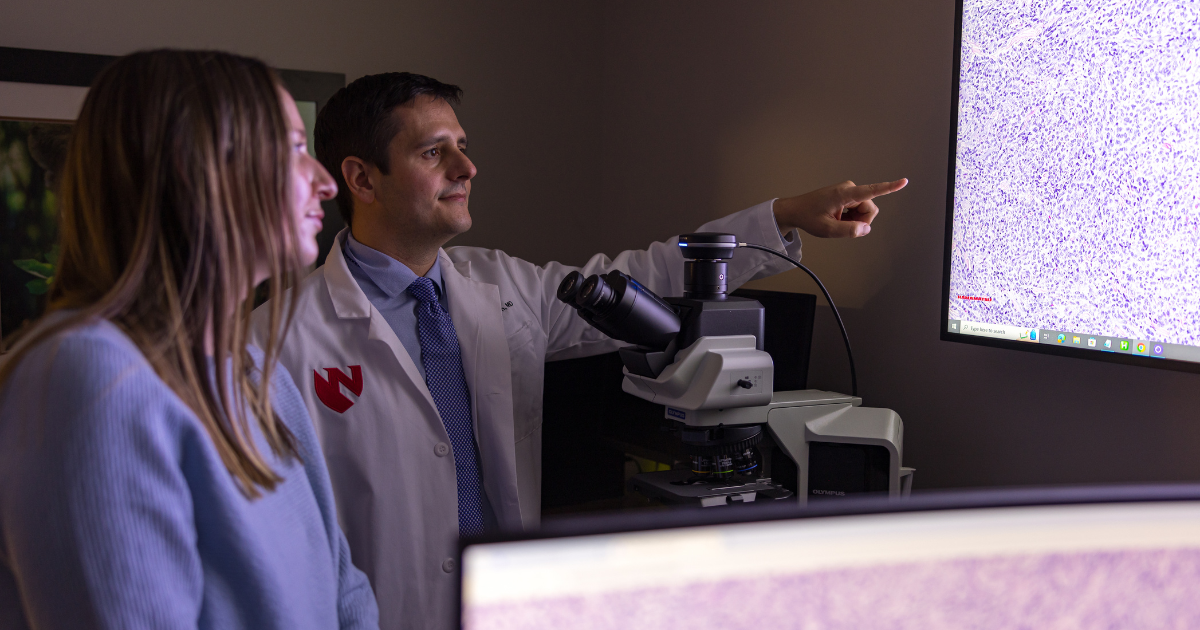
A dermatopathologist is a dermatology physician with specialized training in diagnosing skin diseases.
While a general dermatologist primarily sees patients in person and sends tissue samples to a lab for analysis, a dermatopathologist has additional training to analyze samples directly under a microscope.
Dermatopathology: Puzzle-solving detective work
As subspecialists, dermatopathologists are sometimes referred to as the “Sherlock Holmes of dermatology.” Their main function is to correlate a dermatologist’s suspicions with lab results to provide a more precise diagnosis.
Training requires completion of a residency, followed by an additional 1-year specialty fellowship. By combining clinical dermatology knowledge with specialized lab analysis training, dermatopathologists use microscopic clues to help a patient’s primary dermatologist determine an accurate diagnosis and the most effective treatment plan.
The Nebraska Medicine dermatopathology program
This specialized training and expertise sets the dermatology program at Nebraska Medicine apart. Several team members have this training and can function in both roles, merging patient care with the diagnostic, lab-focused function of pathology.
“I think with our additional training, we have a unique perspective on various conditions,” says dermatopathologist Georgeanne Cornell, DO. “Sometimes pathology doesn’t give us a 100% diagnosis, so we have to think outside the box and look deeper to find answers when a condition is difficult to treat or complex to diagnose.”
Although dermatopathology findings are highly accurate, more complex cases sometimes require additional testing and discussion with the dermatology team to arrive at the most accurate diagnosis.
“Our dermatopathology team’s strength is that we work together as both dermatologists and pathologists,” adds dermatopathologist Corey Georgesen, MD. “If there’s a challenging case, we collaborate to get more opinions with the goal of arriving at a consensus on a diagnosis.”
Conditions and accuracy of dermatopathology
If dermatologists are unsure about what they are seeing, confirmation from a dermatopathologist can help determine the best course of treatment. For example, the differences between psoriasis and eczema require different treatments.
Common conditions a dermatopathologist may see include:
- Complex conditions such as skin cancers, like basal cell or squamous cell carcinoma and melanoma.
- Benign or malignant tumors.
- Inflammatory or infectious diseases.
- Complex skin rashes and moles.
Dr. Cornell adds that an accurate diagnosis is sometimes limited by the quality of the skin sample required for a biopsy. “We can’t diagnose what we can’t see, but when we get a quality sample, we can be very accurate.”
“As with anything in medicine, we have cases that are black and white, which are very accurately diagnosed,” says Dr. Georgesen. “But in other cases it’s not so straightforward. We have to put together a body of evidence to state why we think it is a certain diagnosis, so having lots of resources, specialized testing and other dermatologists we can collaborate with is a real advantage.”
A Nebraska distinction: Leading the way in dermatopathology
As experts in diagnosing complex dermatologic conditions, the Nebraska Medicine dermatopathology program is where providers across the region regularly refer their patients.
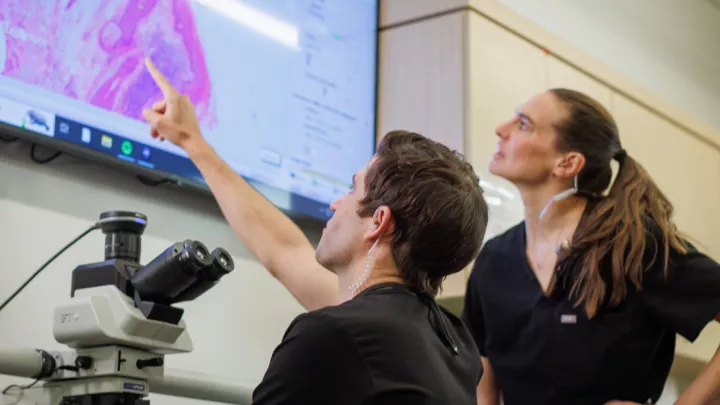
Dr. Georgesen and Dr. Cornell rotate roles between seeing patients and spending time in the lab. They are also active in consults for complicated cases, reviewing biopsies and discussing them at daily sessions. This collaborative approach allows them to blend their expertise to provide the most accurate diagnoses and the highest level of patient care.
“It’s not uncommon for us to talk with dermatologists in the community and surrounding states to consult on a complicated case,” adds Dr. Georgesen.
Nebraska Medicine is also at the forefront of implementing new technology to enhance patient care. This includes the ability to display microscopic slides in a larger digital format and use artificial intelligence to analyze data and assist with diagnosis. The dermatopathology team sees this technology as an enhancement to their own expertise in interpreting complex skin conditions.
“I very much appreciate our team,” adds Dr. Georgesen. “Not only our dermatopathology team, but also working together with the entire dermatology and pathology department and other departments. It’s a very collaborative experience, and I think it's just a very powerful machine for helping patients in a more impactful way.”