Lifesaving proton therapy coming to Nebraska in 2027
Leading-edge proton therapy treatment will soon be available closer to home. The Fred & Pamela Buffett Cancer Center – Nebraska Medical Center will be the first institution in a six-state region to offer proton therapy, beginning in spring 2027.
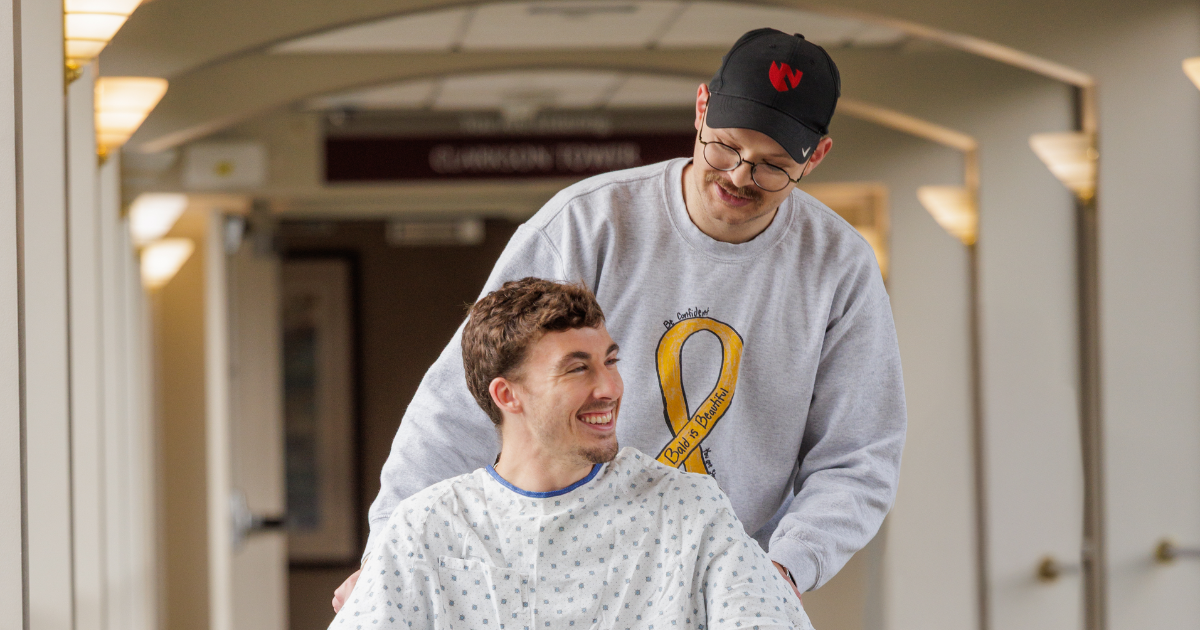
This news brings hope for patients who might face the same journey Will Steinauer, a Nebraska Medicine patient resource assistant, experienced in 2020. Steinauer, then age 20, was diagnosed with a rare brain tumor after what started as double vision while attending college.
A race against time
Steinauer’s diagnosis came with urgent complications. After surgery in January 2020, he experienced multiple brain bleeds that required immediate action. His Nebraska Medicine care team knew he needed proton therapy quickly, but he would have to travel over 1,000 miles to receive it at MD Anderson Cancer Center in Houston.
“It was a major inconvenience, but I didn’t have a choice,” Steinauer recalls. “It was just a miracle that we were able to get in down there.”
Steinauer could only miss two days of radiation therapy in Omaha to travel to Houston for the specialized proton treatment. This meant his family had to coordinate travel between Omaha and Houston with no room for error.
The power of proton therapy
Proton therapy offers major advantages over traditional radiation, especially for young patients. Unlike regular radiation that passes through the entire body, proton therapy offers greater precision.
“With proton therapy, they’re able to target the cancer more accurately and spare some of the surrounding healthy tissue,” Steinauer explains.
Currently, fewer than 50 proton therapy centers exist in the U.S. The $36 million proton therapy project at Nebraska Medical Center will serve patients across Nebraska, Iowa, North Dakota, South Dakota, Wyoming and Colorado.
“I’m excited for the future with proton therapy and the impact it will have not only for Nebraskans but the Midwest in general,” Steinauer says.
Charles Enke, MD, chair of radiation oncology adds, "Proton therapy is indicated for 200,000 patients per year in the U.S. and yet only 9% of those eligible patients are able to receive proton therapy due to problems with this treatment technology being unavailable where they live.
We are excited to bring this newest development in proton therapy to the patients we serve. This advancement will also allow us to expand our ongoing research programs into areas that could not be explored without the availability of proton therapy.