Protect your health. A simple test could save your life.
Colon (colorectal) cancer is one of the most common cancers. It’s also one of the most preventable with regular screening.
Screening can find polyps before they turn into cancer. It can also find cancer early when it’s easier to treat.
Who should get screened?
For most people at average risk:
- Start screening at age 45.
- This is recommended by the U.S. Preventive Services Task Force, National Comprehensive Cancer Network, American Cancer Society, and other expert groups.
- Continue regular screening until at least age 75.
- Ages 76 to 85 should talk with a provider about what is right for them.
You may need earlier screening if you:
- Have a strong family history of colon or rectal cancer.
- Have a personal or family history of colon polyps.
- Have inflammatory bowel disease (Crohn’s disease or ulcerative colitis).
- Have a genetic condition like Lynch syndrome or FAP.
You may need earlier screening if you:
Screening Options
There are two main types of screening tests – stool-based tests and visual exams.
For average-risk adults, you and your provider can choose either type based on your preferences, health history and access.
For people at higher risk (for example, strong family history, certain genetic conditions or history of polyps), colonoscopy is the recommended screening test, because it allows doctors to directly look at the colon and remove polyps during the same procedure.
Important: Any abnormal result from a stool test may require a colonoscopy.
Learn more about stool-based tests.
Learn more about colonoscopy.
Learn more about screening for higher-risk patients.
Which test is right for you
If you are at average risk, you can choose stool tests or colonoscopy.
If you are at a higher risk, colonoscopy is usually recommended.
Your provider can help you decide what is right for you.
Symptoms to not ignore
Talk with your provider if you notice:
- Blood in your stool
- Changes in bowel habits
- Ongoing stomach pain or bloating
- Unexplained weight loss
- Feeling very tired or weak
These symptoms don’t always mean cancer, but they should be checked.
How to get screened
- Talking to your primary care provider about your age, risk factors and which test is best for you.
- Checking your insurance coverage. Most plans cover colon cancer screening tests starting at age 45, but coverage can vary by test type.
- Scheduling the test or requesting an at-home kit.
Frequently asked questions
Q: I feel fine. Do I still need screening?
Yes. Colon cancer can develop without symptoms. Screening helps find it early.
Q: Can I use an at-home test instead of a colonoscopy?
For many average-risk adults, yes. If a result is abnormal, a colonoscopy may be needed.
Q: What if I am worried about the prep?
Many people feel this way. Your care team can help you prepare and make it easier.
Make an appointment today
To schedule your colon cancer screening, call 800.922.0000.
Our Locations
-
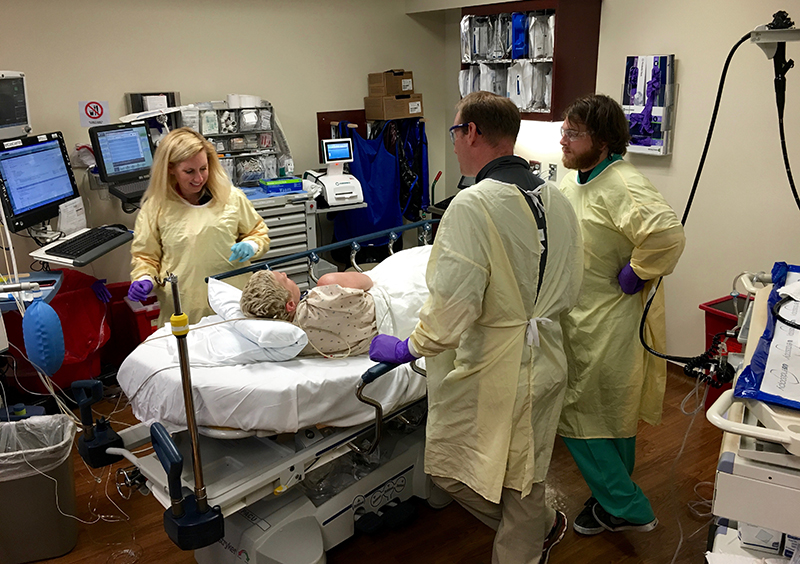
 Endoscopy at Clarkson Tower Image
-
 Family Medicine Clinic at Bellevue Health Center Image
Family Medicine Clinic at Bellevue Health Center
2510 Bellevue Medical Center Drive, Suite 200
Get Directions
Bellevue, NE 68123 -
 Procedures Center at Village Pointe Health Center Image