What Nebraskans need to know about the Iowa lead azide detonation
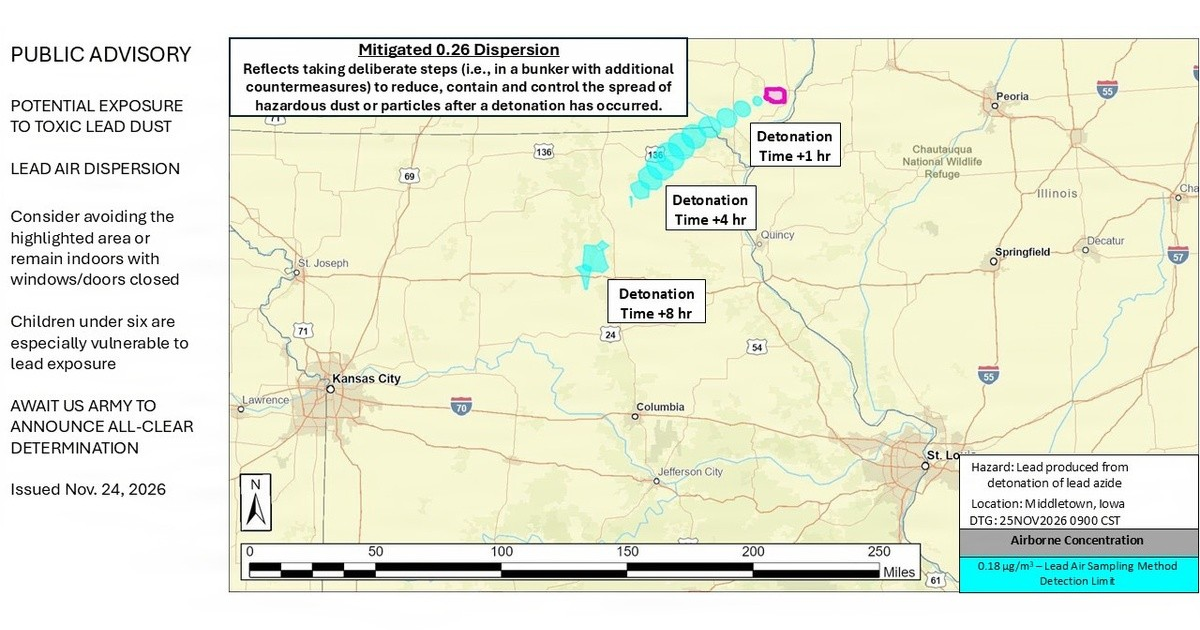
Graphic from U.S. Army
A planned detonation at an Iowa ammunition plant on Wednesday morning could send lead-containing material into the air, but a medical toxicologist says the risk to people in eastern Nebraska is low.
The Army is detonating around 50 tons of lead azide at approximately 9 a.m. CST at an artillery plant in Middletown, Iowa. That is about 275 miles east of Omaha.
To put the potential risks in context, medical toxicologist and emergency physician Ron Kirschner, MD, medical director of the Nebraska Poison Center, explains what the detonation could mean for the health of people in our area.
Are people in eastern Nebraska at risk?
Dr. Kirschner says the risk is low for residents of eastern Nebraska. “I don’t think it will be that great because of the distance. I think that’ll be in our favor,” he says.
That doesn’t mean there is no risk. “If the wind is really blowing in our direction, it’s possible there could be some, but it’s unlikely that it would be major,” Dr. Kirschner says.
Much about the detonation is still unknown, including how well it will be contained and how far dust may travel. “Actual poisoning would be very unlikely, though, for somebody living in this area.”
Why is lead a concern?
Any form of lead can be dangerous because the body has a hard time clearing it.
“The body can absorb lead, but it can’t get rid of it that easily,” Dr. Kirschner says. Lead can be stored in bones, but it is most harmful when it reaches the brain or nervous tissue. However, serious toxicity requires a high level of exposure, he says.
Who is most vulnerable, and what precautions should they take?
“The risk would be greatest in young children and pregnant women, where you really don’t want any lead accumulating,” Dr. Kirschner says. “Lead’s most important effect is neurotoxicity, and the developing brain is more sensitive.”
Inhaling lead dust is the main concern. As a precaution, he recommends that small children and pregnant women stay inside during the planned detonation at 9 a.m. CST and for about six hours afterward. “Staying inside, you’re less likely to inhale any dust that might drift over,” he says.
Time in a vehicle is also fine, he says, because most vehicles have air filters, which is better than breathing outdoor air.
What if weather and wind carry lead particles to our area?
If conditions carry lead particles toward Nebraska, the main concern would be long-term exposure rather than acute toxicity.
“You might see a slight bump in your lead level,” Dr. Kirschner says. “If you’re an adult, chances of getting serious toxicity are pretty small.” Dust could settle in soil, on plants, and on houses, he says, and young children could be exposed by touching surfaces and putting their hands in their mouths.
How can parents lower the risk?
Washing children’s hands after outdoor play and taking shoes off when coming indoors lower the risk of ingesting contaminated soil. “That’s always a good practice,” Dr. Kirschner says.
Children are already tested for lead regularly by their pediatricians. “If they’re getting high lead levels, it’s going to get noticed before they actually get to a level where it’s causing serious harm,” Dr. Kirschner says.
What if I’m concerned about lead exposure?
Adults aren’t typically tested for lead unless they have occupational exposure, Dr. Kirschner says, but anyone with a concern can talk to their regular health care provider. The blood test is sent to a specialized lab, and results usually come back within a week or less.
Call 800.922.0000 or schedule online for an appointment with a primary care doctor. For more immediate advice, call the Poison Control Center at 800.222.1222.