From ‘Why me?’ to ‘Why not me?’: Tyrone's story
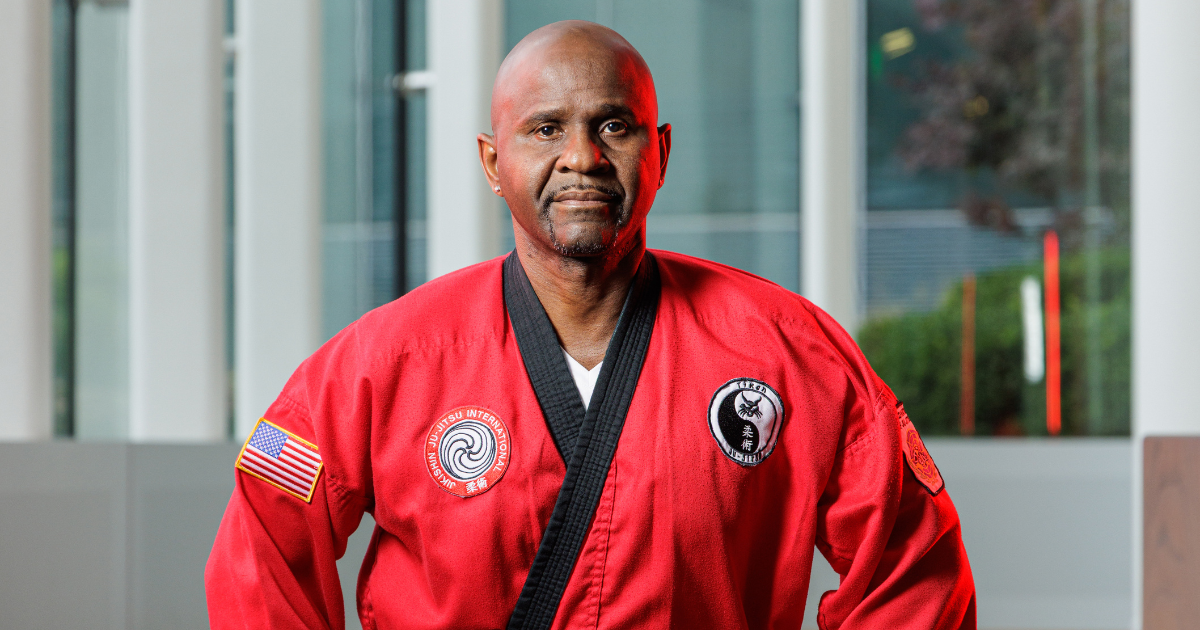
In August 2024, Tyrone Abdul noticed a pea-sized lump on the left side of his neck. He was working full time, teaching fitness and ju-jitsu classes, and riding his bike. He felt fine, but the lump seemed unusual, so he mentioned it during his annual physical.
Blood tests revealed an abnormal protein level, prompting a referral to a hematologist at Nebraska Medicine | Fred & Pamela Buffett Cancer Center. A bone marrow biopsy later showed that 70% of his marrow contained myeloma cells.
He needed treatment right away.
The diagnosis surprised Abdul because he had not experienced the bone pain, fractures, or kidney problems that can accompany multiple myeloma, a blood cancer of bone marrow plasma cells.
Hematologist Tanya Wildes, MD, who treats Abdul, says the disease can look very different from one person to another.
“There can be a range, from patients who have no symptoms to those who have had a dramatic decline in their health,” Dr. Wildes says. “Those diagnosed before symptoms develop are in a much better position to be resilient to side effects of treatment.”
Abdul began outpatient treatment in March 2025. He received an injection twice a week and took an oral medication in 21-day cycles. His main side effect was neuropathy in his feet, but he continued teaching. On Wednesdays, he led a 5:15 a.m. fitness class, showered, arrived at Village Pointe Health Center for treatment, went home for a nap, and returned to teach five evening ju-jitsu classes.
“Honestly, I just kept going,” he says.
After three months, his abnormal protein level had fallen significantly.

In August 2025, he underwent high-dose chemotherapy followed by a stem cell transplant, performed by hematologist and oncologist Christopher D’Angelo, MD. Abdul calls Aug. 21, the date of his transplant, his “rebirthday.”
Before the transplant, his care team prepared him for a stay that might last weeks and for side effects like mouth sores, digestive problems, and loss of appetite. His experience was milder than expected. He continued eating, had limited digestive symptoms, and left after 11 days.
He also walked – a lot – logging a 5K and then a half marathon during his stay. Staff learned to make way when they saw him coming.
His resilience did not come from treatment alone. Ju-jitsu has shaped Abdul’s life since 1992, when he discovered the sport as a 16-year-old college student in South Africa. He later competed internationally, pioneered ju-jitsu in his native Zimbabwe, and immigrated to Omaha in 1999. Today, the sixth-degree black belt teaches children and adults and serves as president of the United Nations of Ju-Jitsu, promoting health, friendship, and community globally through the sport.
Dr. Wildes says Abdul’s excellent physical health helped position him to recover from intensive treatment.
“And his determination to recover from the treatment is an added essential ingredient,” she says.
After his transplant, Abdul temporarily stepped away from teaching and crowds while his immune system rebuilt. He gradually returned to his classes and international travel. He continues monthly treatment and takes medication to help control the disease while preserving his quality of life.
The past two years have also changed how Abdul views his diagnosis. At first, he wondered, “Why me?” Within weeks, the question became, “Why not me?”
“How can I use this to help other people and bring awareness?” he says. “Why can’t I keep going and show strength as well? This could be a sense of encouragement and inspiration for others.”
He hopes to support others facing blood cancer, raise awareness, and give back to the Omaha community that rallied around him. In September, he was recognized as the Adult Honored Hero for Light the Night, a fundraiser organized by Blood Cancer United.
For Abdul, the goal is to keep moving forward – teaching, traveling, and using his platform to help others. “I’m thankful that I have this opportunity to encourage and be there for whoever needs somebody to talk to.”
Multiple myeloma treatment advances
Multiple myeloma treatment is advancing at a phenomenal pace, with highly targeted therapies that can work quickly, Dr. Wildes says. Most recently, in August 2026, the Food and Drug Administration granted accelerated approval to iberdomide, in combination with three other drugs, to treat multiple myeloma.
Although the disease is not yet considered curable, many patients now live 10 to 15 years after diagnosis, and some survive 20 to 30 years, offering growing hope for the future.