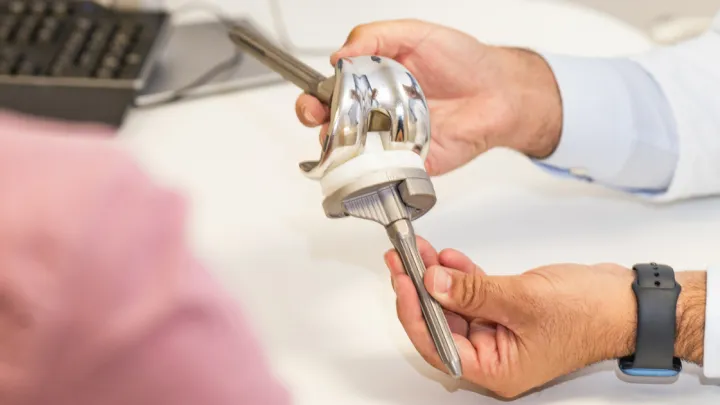
How do you know when it's time for a joint replacement?

Joint pain can creep into your routine so gradually that you may not even notice it. Maybe you’ve stopped taking walks or need help getting out of a chair. You may have become accustomed to joint pain. So when should you consider a joint replacement?
“When it starts to affect your day-to-day activities,” says Nebraska Medicine orthopaedic surgeon Joshuea Cameron, MD. “If you’re having a hard time just walking around your house, or pain is making sleep difficult, those are signs it’s time to consider surgery.”
What causes someone to need a joint replacement?
Arthritis is the most common reason. Osteoarthritis develops as the cartilage cushioning a joint wears down. Other causes can include inflammatory arthritis, such as rheumatoid arthritis, and post-traumatic arthritis that shows up after an injury to the joint. Knees are the most commonly replaced joints, followed by hips and shoulders.
“Joint replacement is generally considered after treatments such as medication, injection, or physical therapy haven’t provided enough relief,” says Dr. Cameron. “Because the procedure replaces part of the joint and cannot be undone, your care team will discuss what you’ve tried and whether surgery can help.”
When it’s time to talk about surgery
There isn’t just one level of pain or X-ray finding that points to someone needing a joint replacement. Rather, it’s what your joint pain keeps you from doing on a daily basis. It might be time for an evaluation if:
- Pain makes it difficult to walk around your home or handle daily tasks
- Joint pain interferes with sleep or wakes you up at night
- Stiffness or reduced movement limits your activities
- Treatments that once helped no longer provide enough relief
- You’ve started giving up activities or become dependent on a cane, walker, or help from others
People will often adjust to these changes without realizing how much their world has narrowed. Dr. Cameron says it’s not unusual to see patients who have lived with significant arthritis for years before seeking care.
What happens at a joint replacement evaluation?
An orthopaedic specialist will ask how long you’ve had symptoms, how they affect your life, and which treatments you’ve tried. The visit typically includes an exam of the joint’s movement, stability, and painful areas. X-rays may be necessary if there aren’t recent images.
X-rays don’t show cartilage directly, but they can show signs of arthritis, including narrowing of the space between the bones, bone spurs, or changes in alignment. But the images are only part of the decision.
“I don’t necessarily base whether someone needs surgery on their X-rays alone,” says Dr. Cameron.
Some people have severe arthritis on imaging but still function well. On the other hand, when someone has significant pain but little or no arthritis on an X-ray, a replacement may be less likely to address the source of pain. The best decision considers both symptoms and imaging.
Can you be too young, or wait too long?
There’s no ideal age for joint replacement. For a younger person who remains highly active, Dr. Cameron may recommend managing symptoms without surgery for a while. Artificial joints can wear out, and someone who has surgery at a younger age may eventually need another procedure. But age alone doesn’t rule surgery out when arthritis is severe, and quality of life has declined.
Waiting also isn’t automatically harmful. In some severe cases, however, further changes to the bone can make surgery more complicated. Recovery may be harder as a person gets older. These are reasons to discuss the timing with a surgeon instead of assuming you either need surgery immediately or put it off.
What can a joint replacement improve?
Joint replacement can reduce arthritis pain and improve movement in a stiff joint. For someone with limited mobility, that might mean getting back to daily activities or regaining some independence. It’s not a promise of a completely pain-free joint, and it may not be the right choice for someone who wants to continue high-impact activities.
Recovery takes work, but many patients begin walking with assistance the day of hip or knee surgery. Dr. Cameron says patients often resume basic daily activities independently within about two to three weeks after a hip replacement and three to four weeks after a knee replacement. Rehabilitation and physical therapy may continue for around three months. Timelines depend on health, the joint involved, and recovery.