New proton therapy will advance cancer care in the heartland
Historically, when cancer patients in the Midwest needed proton therapy, they have had few options close to home.

“There are over 40 proton centers in the country, but they are mostly concentrated on the coasts,” says Charles Enke, MD, chair of radiation oncology. “The central United States is referred to as a ‘proton desert.’”
That’s changing. Nebraska Medicine | Fred & Pamela Buffett Cancer Center will open a proton therapy center in 2027. It will be the first in a seven-state region that includes Nebraska, Iowa, North Dakota, South Dakota, Montana, Wyoming, and Colorado.
How is proton therapy different?
Traditional X-ray radiation passes through the body and exits out the other side. It deposits energy along its entire path, including on healthy tissue beyond the tumor.
Proton therapy works differently. It delivers targeted radiation that builds to maximum intensity at the tumor, then stops before passing through the body. It is frequently used for tumors in the brain, spinal cord, and eyes, and with patients who have already received radiation in an area.
Its precision can be particularly valuable for treating cancers in children, Dr. Enke says.
“With pediatric patients, not only do we have to cure their cancer now, but we also have to make certain they are not experiencing side effects of cancer treatment in 15 to 20 years when they are young adults.”
Smaller machine, bigger impact
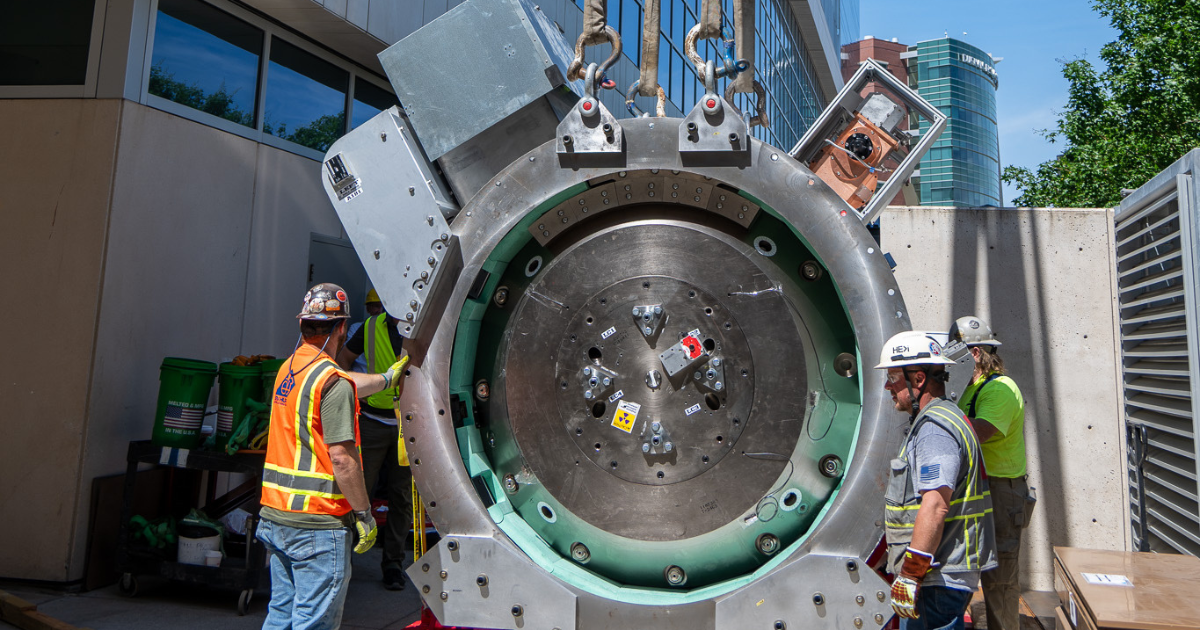
Nebraska Medicine has partnered with Mevion, a Massachusetts-based company, to install the MEVION S250-FIT®. It is the world’s smallest proton accelerator and fits inside an existing treatment room at the Fred & Pamela Buffett Cancer Center – Nebraska Medical Center.
“Previously, these were massive facilities that would cover an entire city block,” Dr. Enke says. “Now the treatment room might have a footprint the size of a tennis court.
The new system treats patients while they sit upright. Unlike traditional methods where the patient lies flat and the machine rotates, this system rotates the patient while the beam stays fixed. This makes treatment more comfortable for those who struggle with breathing or managing stress while lying down.
Care closer to home
More than 200,000 U.S. cancer patients could benefit from proton therapy each year but can’t get it, Dr. Enke says. For many, traveling out of state for weeks of treatment can mean time away from their jobs, family, and friends.
“Nobody likes to be away from home when they’re undergoing cancer therapy,” Dr. Enke says. “You want your support system nearby.”
Soon, patients across Nebraska, Iowa, and the surrounding region won’t have to choose between the best treatment and staying close to home.