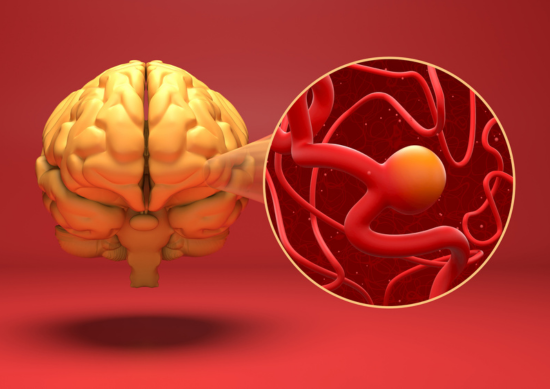
Unruptured intracranial aneurysms (UIAs) are increasingly detected due to the widespread use of high-resolution CT angiography and MRI. Most patients are asymptomatic at diagnosis, and the central clinical challenge is determining whether and how to treat an aneurysm that has not yet ruptured.
Management requires careful assessment of rupture risk, treatment risk and patient-specific factors, with an emphasis on shared decision-making.
Understanding natural history and rupture risk
Most UIAs will never rupture. Large observational studies have shown that annual rupture risk is influenced by:
- Aneurysm size and location.
- Morphology and growth.
- Patient factors such as hypertension, smoking status and family history of subarachnoid hemorrhage.
“In general, small aneurysms under 7 mm in the anterior circulation carry a low annual rupture risk, whereas larger aneurysms, those located in the posterior circulation (e.g., basilar tip, posterior communicating artery), and aneurysms with irregular morphology or documented growth have a higher likelihood of rupture,” says Nebraska Medicine Co-director of the Stroke and Neurovascular Center and Associate Professor of Neurosurgery at the University of Nebraska Medical Center William E Thorell, MD.
Importantly, rupture risk is cumulative over a patient’s lifetime, making age and expected longevity key considerations.
Initial evaluation and risk stratification
Once a UIA is identified, high-quality vascular imaging is essential. CTA and MRA are often sufficient for diagnosis and surveillance, while catheter angiography may be used when treatment is being considered or when the anatomy is complex.
Risk stratification integrates:
- Aneurysm factors: Size, location, shape and growth.
- Patient factors: Age, medical comorbidities, smoking and hypertension.
- Clinical context: Prior subarachnoid hemorrhage from another aneurysm or family history.
Several scoring systems exist to estimate rupture risk, but none replace clinical judgment.
Observation and medical management
For many patients, conservative management is appropriate. This includes serial imaging to monitor for growth (often at six to 12 months initially, then at longer intervals if stable), and aggressive management of modifiable risk factors.
Smoking cessation, blood pressure control and general cardiovascular risk reduction are cornerstones of non-operative care.
Observation is particularly favored in older patients, those with significant medical comorbidities, or those with small, stable aneurysms in low-risk locations.
Interventional treatment options
When the risk of rupture is felt to outweigh the risk of treatment, intervention may be recommended.
Two primary strategies are available:
- Microsurgical clipping, which provides durable exclusion of the aneurysm but requires craniotomy and carries risks of the surgery.
- Endovascular therapy, including coiling, WEB device and flow diversion, which is less invasive but may require long-term antiplatelet therapy and ongoing imaging surveillance and still carries a risk of complications.
The choice of treatment depends on aneurysm anatomy, patient age and health, institutional expertise and patient preference.
Shared decision-making and guidelines
Professional guidance from organizations such as the American Heart Association and the American Stroke Association emphasizes individualized care and shared decision-making.
“Patients should understand that both treatment and observation carry risks, and that 'doing nothing' is often an active, thoughtful choice rather than neglect,” adds Dr. Thorell. “Management of unruptured intracranial aneurysms is fundamentally about balancing the risk between rupture and treatment. Population data, individual factors, medical expertise and patient wishes all need to be considered.”
UIA evaluation and management referrals
The Nebraska Medicine neurosurgery program offers a full range of treatment options and a customized treatment plan for all neurosurgical problems. Our team of experts strongly believes in managing both disease and pain so that a candidate for surgery can achieve the best quality of life and postoperative outcomes.
Dr. Thorell maintains a neurosurgery practice treating brain, skull and spine trauma, tumors and nerve issues. He also played a key role in developing the Stroke and Neurovascular Center with an interdisciplinary medical team at the University of Nebraska Medical Center and Nebraska Medicine.