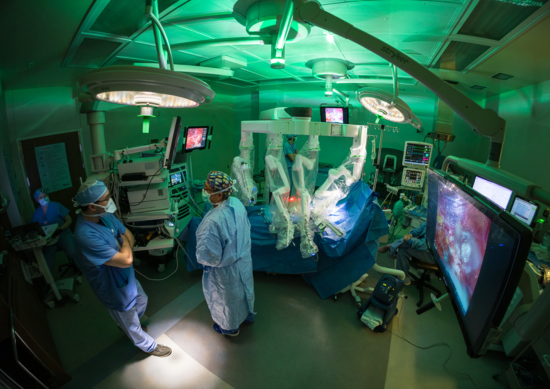
Nearly every Nebraska Medicine surgical specialty now offers robotic-assisted procedures, providing patients with advanced minimally invasive options.
The robotic surgery program has expanded to seven robotic systems across multiple campuses, including:
- Bellevue Medical Center.
- Fritch Surgery Center.
- Hixson-Lied Center ORs.
- Fred & Pamela Buffett Cancer Center ORs.
Enhanced precision and control
Robotic technology delivers several key advantages over traditional surgical approaches. The Nebraska Medicine robotic systems:
- Provide three-dimensional vision with magnification.
- Eliminate natural hand tremor.
- Improve overall visualization.
“The application of energy to control bleeding, for example, is much more precise because of all those factors,” says urologist Chad LaGrange, MD.
Nebraska Medicine recently updated all of its robotic systems to the dV5, the newest robotic system available. The health network is Omaha's sole non-VA provider with this technology. The dV5 offers virtual tactile feedback, allowing surgeons to feel tissue through their instruments, along with improved ergonomics that reduce physical stress during procedures.
The system enables real-time video consultation between specialists during surgery while maintaining HIPAA compliance by keeping all identifying information private. It also provides detailed performance analytics to help surgeons continuously refine their techniques.
Additionally, the dV5 allows surgeons to capture de-identified video and images during procedures for documentation in patient charts, teaching purposes and continuous quality improvement.
Faster recovery for patients
Robotic surgery consistently delivers shorter recovery times and reduced pain compared to open procedures. Many operations now performed robotically would require large incisions without this technology.
Examples of complex procedures now offered through small incisions include:
- Radical cystectomy with intracorporeal urinary diversion for bladder cancer.
- Living donor nephrectomy and kidney transplant surgery.
- Lung surgery without opening the chest or removing ribs.
Comprehensive perioperative care
All robotic surgery patients benefit from the Early Recovery After Surgery (ERAS) protocol. The standardized program aims to promote early recovery after surgery.
“We have multiple interventions before the surgery ever takes place to help reduce pain and improve outcomes and decrease length of stay in the hospital,” Dr. LaGrange says.
Depending on the case, the ERAS program may include:
- Specialized preoperative drinks to improve bowel function.
- Pain modulators given days before surgery.
- Long-acting anesthetic blocks to decrease narcotic requirements.
Collaborative approach drives growth
The Nebraska Medicine Robotic Steering Committee, chaired by Dr. LaGrange, brings together surgeons who perform robotic procedures.
“All the robotic surgeons from different specialties work together,” Dr. LaGrange says. “We run a committee where we discuss robotic issues in collaboration.”
Since the committee’s formation several years ago, the program has grown from two or three robotic systems to seven, with volumes increasing every year. The program continues to expand with plans to add more robotic surgeons.
How to refer
To refer patients for robotic surgical evaluation, email physicianoutreach@nebraskamed.com. For urgent transfers, call 800.258.0029.