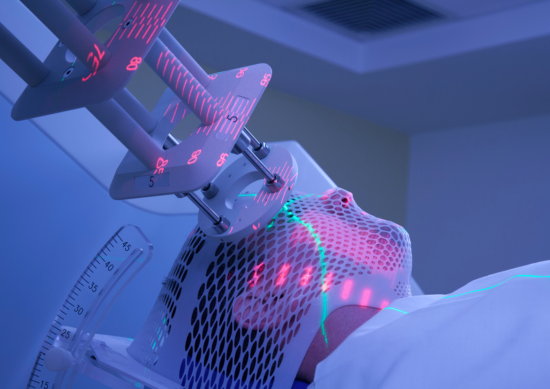
Nebraska Medicine | Fred & Pamela Buffett Cancer Center is bringing proton therapy to the region in March 2027, marking a significant milestone in cancer treatment accessibility.
Why proton therapy now?
Charles Enke, MD, Chair of Radiation Oncology, explains the strategic timing: “We have looked at bringing proton therapy to Nebraska Medicine for over 10 years. The technology has evolved dramatically – what once required massive facilities covering a city block can now be installed in a standard radiation therapy room.”
The science behind proton therapy
Proton therapy delivers radiation using the Bragg peak phenomenon – radiation dose builds to maximum intensity at the target, then drops to zero with no exit dose. This contrasts with traditional X-ray radiation that passes straight through the body.
This precision targeting minimizes radiation exposure to healthy tissue, making it particularly valuable for:
- Pediatric patients: Reduces secondary cancer risk and protects developing organs.
- Brain tumors: Limits radiation to critical brain structures.
- Head and neck cancers: Dramatically reduces complications like aspiration problems or need for feeding tubes.
- Re-treatment cases: When patients need additional radiation after previous treatment.
Innovative upright treatment
The Mevion S250-FIT proton therapy system with upright positioning technology is being installed in an existing vacant radiation therapy treatment room located at the Fred & Pamela Buffett Cancer Center on the Nebraska Medical Center campus.
“We will be the second of four major academic medical centers to offer this innovative proton therapy technology,” Dr. Enke says. Stanford University recently completed its construction project, while Loma Linda University and Dana-Farber Cancer Institute have announced plans to add the MEVION S250 FIT.
The MEVION S250-FIT features:
- The world's smallest proton accelerator.
- Upright patient positioning and CT imaging in front of a fixed beam line.
- Rotational Arc Proton Therapy.
Dr. Enke describes how the MEVION S250-FIT “disrupts” the traditional proton therapy model.
“Instead of moving a 15-ton cyclotron or massive beam gantry around the patient, what if we just park the cyclotron on the floor and move the patient?” he asks. The analogy he uses: traditional proton therapy is like “having a person hold a light bulb while the moving company rotates the house” versus simply keeping the house still and screwing in the bulb.
The upright positioning system offers significant benefits:
- Improved comfort for patients with breathing difficulties.
- Less claustrophobia compared to traditional lying treatment position.
- Easier secretion management for head and neck cancer patients.
- Lower radiation dose to critical organs with upright positioning.
- Built-in upright CT scanner for precise image guidance in treatment position.
Addressing a critical gap
Currently, only 9% of patients who have recognized indications for proton therapy in the U.S. are able to receive this treatment. There are over 180,000 patients per year who would likely benefit from proton therapy but don’t have access due to limited availability of proton therapy facilities. The nearest centers to Nebraska are in Kansas City, Rochester, Salt Lake City and St. Louis.
The new proton therapy unit will serve not only Nebraska but potentially patients from Iowa, Kansas, South Dakota and Colorado – states that currently have limited or no proton therapy access.
Research and future capabilities
Flash radiotherapy research
The system includes capabilities for Flash radiotherapy research, delivering ultra-high radiation doses in seconds rather than hours. “It will allow us to give a course of treatment in under two seconds that would otherwise take up to 40 treatments over eight weeks,” Dr. Enke explains. The Flash effect spares normal tissue but not cancer tissue.
Future vision
“I think upright proton therapy, in five years, will be the dominant technology that will be installed,” Dr. Enke predicts. Nebraska Medicine and UNMC’s position as a pioneering academic institution places it at the forefront of this technological evolution.
Dr. Enke’s wish list for complementary technology includes upright MRI scanning, which would provide optimal imaging in the same position used for treatment planning and delivery.
Timeline
- Current status: On time and on budget at around $36 million.
- Equipment delivery: March 2026 (15-ton cyclotron).
- Clinical operations: March 2027.
For questions about proton therapy or patient referrals, contact physicianoutreach@nebraskamed.com. Radiation Oncology plans to begin treating patients in March 2027.