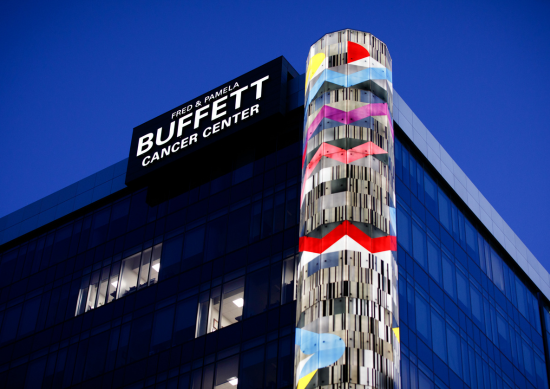
When a patient receives a prostate cancer diagnosis, the expertise behind their care team shapes everything that follows. Every member of the Nebraska Medicine | Fred & Pamela Buffett Cancer Center prostate cancer team focuses specifically on genitourinary (GU) malignancies, which include prostate, bladder, kidney, and testicular cancers. That depth of sub-specialization distinguishes this program from general oncology practices across the region.
A team built around genitourinary oncology
Genitourinary (GU) medical oncologist and hematologist Harshraj Leuva, MBBS, has seen firsthand what focused expertise means for patient outcomes.
“It’s not just the physicians,” Dr. Leuva says. “The whole team gets sub-specialized. The care is very much focused toward prostate cancer or genitourinary malignancies, rather than a general, any-type-of-cancer approach.”
The team includes urologists Chad LaGrange, MD, Andrew Christiansen, MD, and Jared Schober, MD; radiation oncologists Michael Baine, MD, Charles Enke, MD, and Thomas Pugh, MD; medical oncologists Dr. Leuva and Benjamin Teply, MD; radiologists Antonia Gurney, MD, and Neil Hansen, MD; and GU pathologist Subodh Lele, MD.
A third medical oncologist and a fellowship-trained uro-oncologist will join the team in the coming months, expanding capacity to meet growing patient volume.
Complex cases are reviewed at a dedicated GU tumor board, where the full team discusses each patient. New patients are evaluated in a multidisciplinary clinic, seeing urology, radiation oncology, and medical oncology in a single visit.
That collective expertise is recognized at the national level – and held to a high standard.
The advantage of National Cancer Institute (NCI) designation
Fred & Pamela Buffett Cancer Center is Nebraska’s only NCI-designated cancer center, a distinction that requires meeting rigorous standards across clinical outcomes, research, and patient services, and is subject to ongoing review.
“In addition to achieving excellent patient outcomes, we need to maintain research programs, organizational capabilities, and shared resources to accelerate multidisciplinary research, provide education, and conduct community outreach to be a National Cancer Institute-designated cancer center,” Dr. Leuva says. “It is not that you get designated once and you never get reviewed.”
That designation also underpins the program’s robust GU clinical trial portfolio. Patients have access to trials across multiple treatment phases, including some that require significant infrastructure, such as Phase 1 studies and immunotherapy trials involving BiTE and CAR-T approaches, which are not widely available in the region.
“Our goal is that patients in our region should not have to travel to participate in a clinical trial,” Dr. Leuva says.
Advances in treatment
The program offers a full range of FDA-approved therapies alongside investigational options not available at most regional centers:
- Shorter-course radiation: The radiation oncology team is actively participating in clinical trials comparing one week of treatment to the traditional four-to-six weeks – a meaningful quality-of-life consideration for patients
- Proton therapy: A proton radiation machine is scheduled to become operational next year
- Robotic surgery: Advanced robotic capabilities and surgical expertise are available for urologic cancers, including rare GU malignancies such as testicular cancer
- Radiopharmaceuticals: PLUVICTO (lutetium PSMA-617), an IV radiopharmaceutical, is administered on-site (not available at many regional centers)
- Clinical trials: Patients have access to investigational agents not yet FDA-approved through the program’s expanding trial portfolio
When to refer
For primary care providers, Dr. Leuva recommends prompt referral to urology when patients present with urinary symptoms – regardless of PSA level.
“Once you have symptoms, PSA plays a less central role,” he says. “You still have to evaluate.” He notes that cases have been delayed when providers waited for PSA elevation before acting on symptoms.
Fast-rising PSA trends also warrant closer monitoring, even when values remain within the normal range.
For specialists managing patients with metastatic disease, Dr. Leuva encourages earlier consultation with medical oncology.
“If you start seeing progression on hormonal therapy, that is a very important time to refer to a medical oncologist who sub-specializes in this,” he says. “The intensity of therapy drastically changes. If you refer patients too late, most of the time they are not in a good enough state to receive more treatment.”
Multiple sites, collaborative approach
Clinical services are available at Fred & Pamela Buffett Cancer Center – Nebraska Medical Center, Fred & Pamela Buffett Cancer Center – Bellevue Medical Center, and Fred & Pamela Buffett Cancer Center – Village Pointe Health Center. Radiation oncology services are available at Nebraska Medical Center and Village Pointe locations.
The team also welcomes one-time clinical trial consultations. Referring providers and patients can reach out to determine whether a trial is appropriate, without committing to a full transfer of care. Patients can continue with their current provider while the team assesses eligibility and identifies future options.
“We work with everybody,” Dr. Leuva says. “We are not trying to take over other oncologists’ patients, but if there are clinical trials that suit the patients, we would welcome a referral.”
To refer a patient or request a consultation, call 402.559.5600.