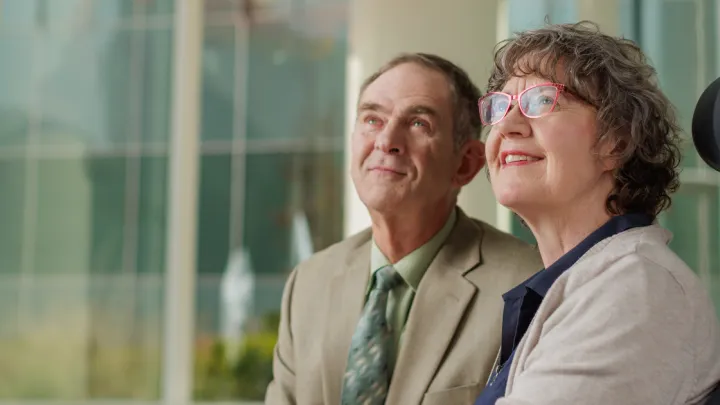
Wendy Wessling began her cancer journey over a decade ago. With her husband Tom and four children by her side, Wessling embarked on a journey she never thought she’d have to face.
Kathy Folk never expected to become a medical pioneer. But 13 years after her cancer diagnosis, Folk made history as Nebraska’s first outpatient CAR T-cell therapy patient.
Jan Janisch-Hanzlik had been having strange symptoms for several years, was diagnosed with MS, and referred to Rana Zabad, MD. Dr. Zabad offered her a new option: enrollment in a first-of-its-kind clinical trial using allogeneic CAR T-cell therapy.
When Kim Bate went to an appointment with his family physician in October 2018, he didn't consider the worst-case scenario. Bate had a rash, but nothing too extreme. Still, when Kim's doctor informed him that he believed Kim had an undiagnosed cancer and they'd need to run more tests, it wasn't a complete surprise.
When Phil Painter learned he had stage 4 prostate cancer last year, he wasn’t sure what the future would hold. A PET/CT scan revealed he would be the perfect candidate for a new FDA-approved prostate cancer treatment called PLUVICTO. In August, he became the first Nebraska Medicine patient to receive this treatment.
In recent months, multiple cancer drugs have been in short supply in the United States. While the Food and Drug Administration and the American Society of Clinical Oncology have been working to resolve the shortages, patients with cancer are understandably concerned about getting the cancer treatment drugs they need and the amount required when the time comes.
As cancer treatments continue to advance and new therapies are introduced, it’s easy to get lost in your search for information. To help you better understand the differences between specific cancer treatments and how they work, we spoke with medical oncologist Bhavina Sharma, MD, MPH.
You’re about to leave the Nebraska Medicine website. The other site may collect information about your visit, including your IP address. Do you want to continue?