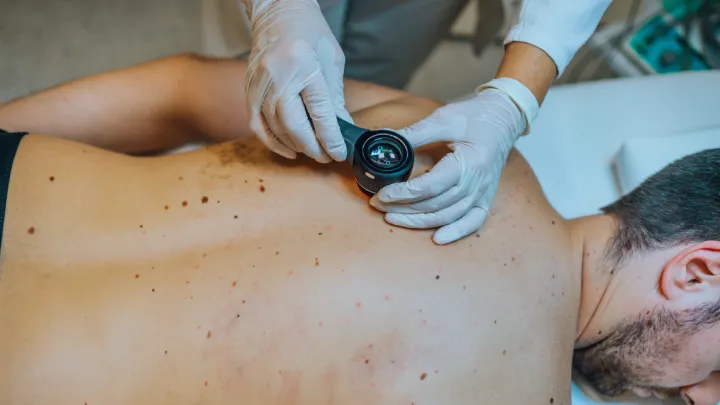
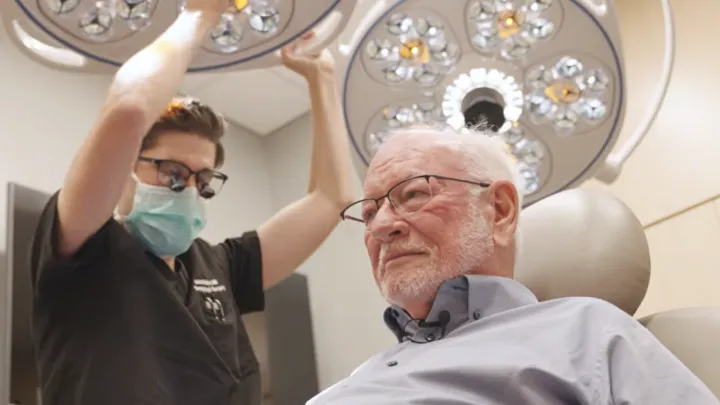
While a general dermatologist primarily sees patients in person and sends tissue samples to a lab for analysis, a dermatopathologist has additional training to analyze samples directly under a microscope.
Question: When should I see a dermatologist? Is that someone I should visit regularly and start seeing at a certain age? Or should I only visit one if I have a concern? Answer from Nebraska Medicine dermatologist Georgeanne Cornell, DO.
When Douglas Smith learned he had melanoma, he knew it was serious. “I was scared about the next steps,” Douglas says. “But from the first appointment to the last, it was really terrific.”
Melanoma is a serious form of skin cancer that starts in the cells that give skin its color. It can spread to other parts of the body if not addressed promptly.
At 53, Melissa Hays embodies resilience. Her journey with melanoma—a life-changing disease—has been shaped by self-advocacy, determination and the support of a coordinated care team.
Question: Are my freckles a sign my SPF isn’t working? Are they signs of sun damage? I’ve always thought they were just genetic. Answered by board-certified dermatologist Jesse Hirner, MD.
Melanoma is a type of cancer that originates from cells that produce the pigment responsible for our skin color. Understanding what melanoma looks like and where it can be found on the body can help with early diagnosis and treatment.
Every year, nearly 80,000 new cases of melanoma are diagnosed, causing over 10,000 deaths annually. The incidence of melanoma is increasing by 2.6% every year and faster than almost every other malignancy.
Mohs surgery is an effective way to treat skin cancer. By pinpointing the cancer and removing it with precision, Mohs surgery gives high cure rates and allows for tissue conservation.
You’re about to leave the Nebraska Medicine website. The other site may collect information about your visit, including your IP address. Do you want to continue?