What is Dupuytren’s contracture? Signs, symptoms, and treatment
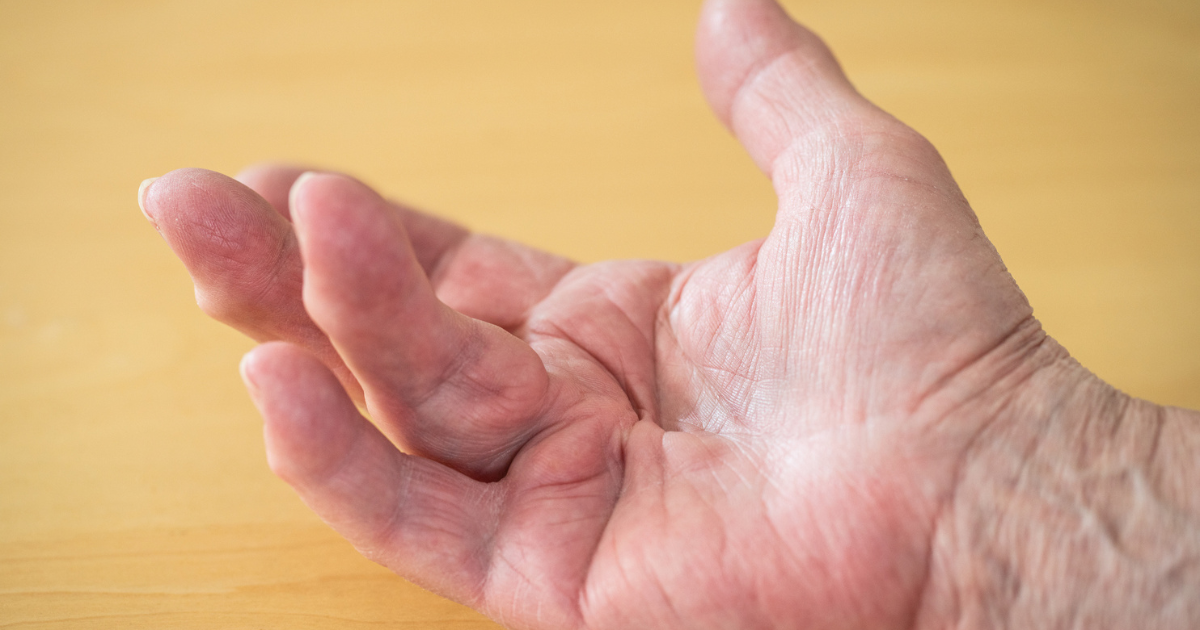
Lay your hand flat on a surface nearby. It’s something we all do every day and don’t think much about it. But for those with a condition called Dupuytren’s contracture, the fingers slowly curl toward the palm rather than lie flat.
While not dangerous, Dupuytren’s contracture can make everyday tasks more difficult over time. The good news is that many people don’t need treatment right away, and several options are available if it begins impacting hand function.
What is Dupuytren’s contracture?
Dupuytren’s contracture affects the tissue beneath the skin of the palm. Over time, that tissue thickens and tightens, forming cords that pull one or more fingers toward the palm.
“It often gets mistaken for a tendon problem because the fingers are bent,” says Nebraska Medicine hand surgeon James Willcockson, MD. “But the tendons are normal. It’s the tissue under the skin that’s contracting.”
The condition often develops slowly over many years.
Who is most at risk?
Also called “Viking’s disease,” Dupuytren’s contracture is most common in people of Northern European ancestry. It’s largely hereditary, but it doesn’t affect everyone the same way.
“It presents differently in each person,” says Dr. Willcockson. “Even within the same family, one person may develop a mild case while another has more severe contractures.”
Men are more likely to develop the condition about 10 years earlier than women and often show more severe symptoms. Because it begins earlier, there is more time for symptoms to progress.
Repeated stress or minor injuries to the hand over many years, especially from manual labor, can also contribute to worsening symptoms.
What are the first signs?
Early symptoms are typically subtle. You might notice:
- A small lump or thickened area in your palm
- Thick cords under the skin
- Difficulty placing your hand flat on a surface
- One or more fingers, usually the ring or small finger, bending toward the palm
One of the easiest ways to recognize the condition is with the tabletop test.
“If someone can’t place their palm flat on a table, that’s often one of the first signs we see,” says Dr. Willcockson.
Unlike arthritis and other hand conditions, Dupuytren’s contracture is usually not painful.
How is Dupuytren’s contracture diagnosed?
Doctors can usually diagnose Dupuytren’s during a physical exam.
Your provider will examine your hand, feel for thickened cords beneath the skin and measure how much your fingers can straighten.
X-rays may be taken to rule out other conditions, but they aren’t typically needed to diagnose Dupuytren’s itself.
When to see a doctor
For most people, the condition progresses slowly over time.
“It often changes in small steps,” says Dr. Willcockson. “Someone may notice a little bending, then nothing changes for a few years before it progresses again.”
In many cases, it takes 10 to 20 years for significant contractures to develop.
If you notice that your fingers are bending or you can no longer lay your hand flat on a surface, it’s time to schedule an evaluation. Early diagnosis allows your doctor to monitor the condition and discuss treatment options before it begins to limit hand function.
How is Dupuytren’s contracture treated?
Treatment depends on how much the contracture affects daily life.
If the finger is only slightly bent, your provider may recommend monitoring the condition with regular follow-up visits.
For early cases, nighttime splinting and stretching may help maintain finger motion, although they won’t cure the condition.
As the contracture progresses, some treatment options include:
Collagenase injections
Collagenase (brand name Xialfex ®) is injected into the cord that’s pulling the finger downward. After a few days, your provider gently stretches the finger to help break apart the weakened cord and help with motion.
Needle aponeurotomy
A small needle weakens or divides the cord beneath the skin, allowing the finger to straighten. It’s a minimally invasive procedure.
Surgery
In advanced cases, surgery removes the diseased tissue causing the contracture. Additional procedures may be performed in some cases to help lengthen tight skin and improve finger movement.